
Berry Hair Color: Shades, Coloring & Maintenance Guide
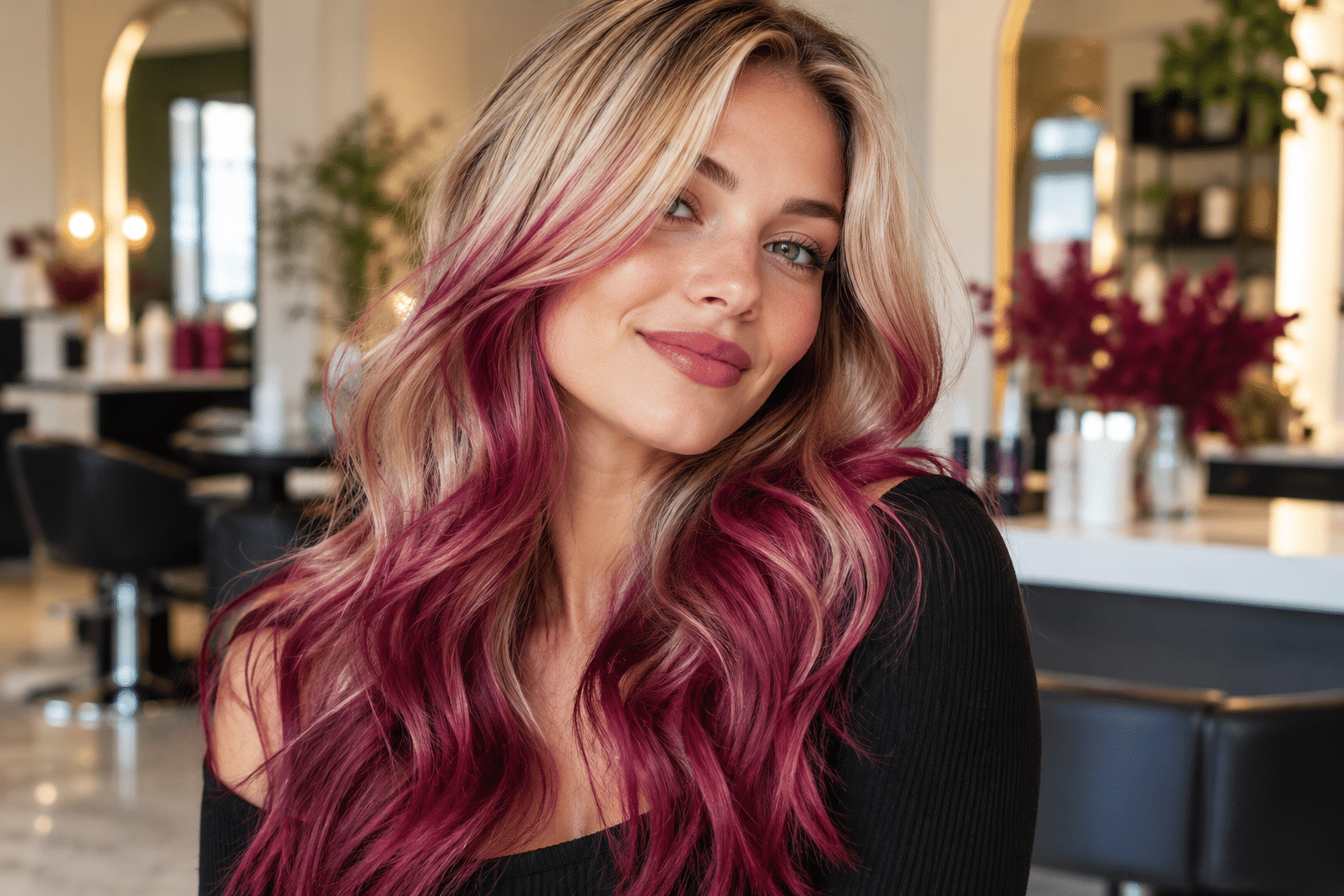
Berry hair color combines rich red, violet, pink, burgundy, and blue-toned shades inspired by raspberries, cranberries, blackberries, blueberries, and other deep fruit colors. Depending on the formula and placement, berry tones can create anything from a subtle dimensional accent to a dramatic full-color transformation.
One reason berry shades are so versatile is that they aren’t limited to one exact color. A stylist can adjust the balance of red, violet, pink, or blue to create a customized shade that works with your starting hair, desired intensity, and personal style.
Before choosing your color, it helps to understand the different berry shades, whether your hair may need lightening, and the berry hair maintenance required to keep vivid tones looking fresh.

What Is Berry Hair Color?
Berry hair color isn’t one standardized shade. Instead, the term describes a family of colors inspired by rich berry tones.
Depending on the desired result, berry hair may contain combinations of:
- Raspberry red
- Cranberry
- Blackberry
- Blueberry
- Mulberry
- Deep burgundy
- Plum
- Violet-red
- Berry pink
The result can lean warmer and redder or cooler and more violet depending on the formula.
Why Choose Berry Hair Color?
Berry tones offer a broad range of possibilities because they sit between several color families.
Someone who doesn’t want bright red hair may prefer a deeper raspberry or blackberry shade. Meanwhile, a client who likes purple but wants additional warmth may prefer a violet-red berry blend.
Berry shades can also be incorporated into highlights, dimensional color, ombre, face-framing pieces, or a complete transformation.
Popular Berry Hair Color Shades
Choosing berry hair begins with deciding which part of the berry spectrum appeals to you most.
Raspberry Berry Hair Color
Raspberry hair typically combines vivid red with pink or violet undertones.
It can range from a brighter jewel-toned raspberry to a deeper, more sophisticated red-violet shade.
Cranberry Hair Color
Cranberry usually emphasizes rich red while incorporating enough coolness to distinguish it from warmer copper or orange-red hair.
Depending on the formula, cranberry can appear bright and vibrant or deeper and more subdued.
Blackberry Hair Color
Blackberry hair typically falls toward the darker end of the berry spectrum.
Deep violet, burgundy, and dark red tones can create a rich color that may appear almost brunette in lower lighting while revealing more berry dimension in brighter light.
Blueberry Hair Color
Blueberry-inspired hair leans considerably cooler. It may combine blue, violet, and darker jewel tones for a dramatic finish.
The starting base plays an especially important role in determining how accurately cooler blue-violet tones appear.
Mulberry Hair Color
Mulberry generally combines red, purple, and burgundy tones.
It can be an excellent direction for someone who wants noticeable creative color without choosing an extremely bright pink or blue.
Berry Hair Color Can Be Bold or Subtle
You don’t have to color your entire head a bright berry shade.
A professional colorist can adjust both intensity and placement to create a result that matches your comfort level.
Options can include:
- Full berry color
- Berry highlights
- Face-framing berry pieces
- Peekaboo color
- Berry ombre
- Dimensional berry balayage
- Berry ends
- Color-blocked sections
- Berry blended with natural brunette
Does Berry Hair Color Require Bleaching?
Not necessarily, although lightening may be needed depending on your starting color and desired brightness.
Deep berry shades may show beautifully on some darker bases without requiring the hair to become extremely light first.
However, bright raspberry, vivid pink-red, blueberry, or intense violet shades generally need a lighter canvas to display their full vibrancy.
Your stylist should evaluate your starting hair before deciding how much lightening is appropriate.
Berry Hair Color on Dark Hair
Brunettes can wear berry hair beautifully.
Deeper cranberry, blackberry, burgundy, mulberry, and violet-red shades can complement a darker base while preserving dimension.
If you want brighter berry pieces, selected sections may need to be lightened before applying the vivid color.
This can allow the stylist to create noticeable berry accents without necessarily lightening the entire head.
Berry Hair Color on Blonde Hair
Blonde hair provides a lighter canvas, which can make berry pigments appear significantly brighter.
However, the existing blonde tone still matters.
Warm yellow blonde, neutral blonde, platinum, and previously toned blonde can each influence how the finished berry color appears.
Your stylist may need to adjust the formula based on those underlying tones.
Berry Hair Color on Previously Colored Hair
Previous artificial color can influence both the process and the final result.
Before your appointment, tell your stylist about previous:
- Permanent color
- Box dye
- Highlights
- Bleach
- Balayage
- Henna
- Vivid colors
- Color removers
- Other chemical services
An accurate color history allows your stylist to develop a more realistic plan.
Choosing a Berry Hair Color for Your Skin Tone
There isn’t a rule saying a particular skin tone can only wear one berry shade.
Instead, a colorist can adjust the warmth, coolness, brightness, and depth of the formula.
For example, someone who prefers warmer tones might gravitate toward raspberry or cranberry, while someone wanting a cooler result may prefer blackberry, plum, or blueberry influences.
Your personal preference remains an important part of the decision.
Berry Hair Color Consultation

A consultation is particularly useful before a creative color transformation because words such as berry, raspberry, burgundy, plum, and cranberry can mean different things to different people.
Bring several inspiration photographs to your appointment.
Your stylist can then identify the characteristics you like and discuss:
- Your desired shade
- Color intensity
- Placement
- Starting hair color
- Previous color history
- Hair condition
- Required lightening
- Maintenance
- Future color plans
How Professional Berry Hair Color Is Created
The exact coloring process varies according to your starting point.
Step 1: Evaluate Your Starting Hair
The stylist evaluates your natural color, existing artificial color, hair condition, texture, and previous chemical services.
Step 2: Determine Whether Lightening Is Needed
If the desired berry shade requires a lighter canvas, the stylist determines which sections need to be lightened and to what level.
Step 3: Create the Berry Formula
The color formula can then be customized according to whether you want more red, violet, pink, burgundy, or blue influence.
Step 4: Apply the Color
The stylist applies the customized formula using the placement required for your desired result.
Step 5: Rinse, Style and Evaluate
After processing, the hair is rinsed and styled so the finished color can be evaluated in its completed state.
Full Berry Hair Color
Full berry color makes the creative shade the dominant color throughout the hair.
This can create a dramatic transformation, particularly when moving from a natural brunette or blonde into a saturated raspberry, cranberry, blackberry, or violet-red shade.
The amount of preliminary lightening depends on the desired brightness and starting hair.
Berry Highlights
Highlights are an excellent option for introducing berry tones without making them the dominant color.
The stylist can place selected sections throughout the hair while preserving more of your natural or existing color between them.
This creates contrast and dimension while still allowing the berry shade to stand out.
Berry Face-Framing Highlights
Berry-colored pieces around the face can create a noticeable change without requiring a full-head transformation.
Depending on your haircut and preferred style, these sections can be subtle or intentionally bold.
They can also be combined with additional berry pieces throughout the hair for a more cohesive effect.
Berry Ombre Hair
Berry ombre maintains greater depth toward the roots and gradually introduces berry color through the mid-lengths and ends.
This can work especially well for clients who want vivid color while preserving a darker natural-looking root area.
The transition can be subtle or dramatic depending on the desired contrast.
Berry Balayage and Dimensional Color
Customized color placement can create berry dimension rather than one solid shade.
A stylist can strategically distribute berry tones throughout the hair while maintaining depth between lighter or brighter sections.
Bell Arte Hair Studio also offers professional balayage hair coloring for clients interested in customized dimensional placement and blended color.
Berry Hair Color vs. Burgundy
Burgundy and berry colors can overlap, but berry is a broader category.
Burgundy typically emphasizes deep red and violet tones. Berry color can include burgundy but may also move toward brighter raspberry, pink-red, blueberry, blackberry, or plum shades.
Therefore, two clients asking for berry hair could want completely different finished colors.
Berry Hair Color vs. Purple Hair
Purple hair generally places violet at the center of the finished color.
Berry hair often incorporates violet but usually blends it with noticeable red, pink, burgundy, or blue influences.
A blackberry shade, for example, may lean close to purple, while raspberry can appear considerably redder.
Berry Hair Color vs. Red Hair
Traditional red hair may include copper, auburn, ginger, or warm red tones.
Berry shades generally lean toward red-pink, red-violet, burgundy, or blue-red rather than orange-red.
If you want a cooler red without moving completely into purple, a berry shade may offer the balance you’re looking for.
Berry Hair Color vs. Pink Hair
Pink hair can range from pale pastel to intense magenta.
Berry shades typically introduce additional red, purple, or burgundy depth.
For someone who likes pink but wants something richer or darker, raspberry or berry-pink can provide an alternative.
How Long Does Berry Hair Color Last?
There isn’t one exact lifespan for berry color.
How quickly it changes depends on:
- The specific formula
- Starting hair color
- Hair porosity
- Previous lightening
- Washing frequency
- Water temperature
- Heat styling
- Sun exposure
- Swimming
- Home-care products
Creative colors generally require more ongoing maintenance than many natural-looking shades.
Berry Hair Maintenance Starts With Washing
Berry hair maintenance begins with your cleansing routine.
Ask your stylist which shampoo and conditioner are appropriate for the color formula and your particular hair type.
You also don’t necessarily need to wash your hair simply because another day has passed. Washing frequency should reflect your scalp, lifestyle, texture, and actual cleansing needs.
Use Products Designed for Color-Treated Hair
Choose products appropriate for professionally colored hair.
Your individual texture still matters. Fine hair may require lighter conditioning than thick, coarse, curly, or heavily lightened hair.
Rather than purchasing every product marketed for vivid color, ask your stylist which products your particular hair actually needs.
Can Hot Water Affect Berry Hair Color?
Very hot water isn’t ideal when you’re trying to preserve vivid color.
You don’t need to take an uncomfortable cold shower. However, avoiding excessively hot water can be a practical part of maintaining your color.
Protect Berry Hair From Excessive Heat
If your hair was lightened before the berry color was applied, protecting its condition becomes particularly important.
Apply heat protection before blow-drying, curling, or straightening, and avoid automatically choosing the highest temperature on your styling tools.
The American Academy of Dermatology provides recommendations for reducing common causes of hair damage, including excessive heat styling.
Florida Sun and Berry Hair Maintenance
For clients in Tampa and throughout Florida, extended outdoor exposure is worth considering when maintaining creative color.
If you’re spending several hours outside, a hat can provide a simple physical barrier for both your hair and scalp.
This can be especially useful during beach trips, boating, festivals, outdoor sports, and other activities involving prolonged sun exposure.
Swimming With Berry Hair Color
Pool and saltwater exposure can complicate maintenance of vivid hair colors.
Consider wetting your hair with clean water before swimming. Afterward, rinse thoroughly instead of allowing chlorine or saltwater to remain in the hair.
If you swim frequently, mention this during your consultation so your stylist can account for it when recommending your maintenance routine.
Why Does Berry Hair Fade?
Creative pigments gradually change as the hair is washed and exposed to everyday styling and environmental factors.
How berry color fades depends on the specific pigments in the formula and the condition of the hair underneath.
A raspberry shade may evolve differently from blackberry or blueberry hair.
Berry Hair Can Fade Differently From Roots to Ends
Hair porosity can vary throughout the length of the hair.
Previously lightened or more porous ends may absorb and release pigment differently from healthier sections closer to the scalp.
As a result, vivid color doesn’t always change uniformly.
Can Berry Hair Color Be Refreshed?
Yes. Depending on the condition of your hair and how the color has changed, your stylist may be able to refresh the berry pigment without repeating the entire original lightening process.
If new growth or a different placement needs to be addressed, a more extensive color appointment may be necessary.
Your stylist can determine which service is appropriate after evaluating the current color.
How Often Does Berry Hair Need Touch-Ups?
The answer depends partly on how you want the color to look.
Someone who wants an intensely saturated raspberry shade may choose to refresh it sooner than someone who enjoys the softer tones that develop as the color changes.
Placement also matters. Full color beginning close to the scalp creates different maintenance needs from berry ombre, highlights, or hidden color.
Keeping Berry Hair Looking Shiny
Vivid color tends to look its best when the hair itself appears smooth and well maintained.
Helpful habits can include:
- Using appropriate conditioner
- Limiting unnecessary high heat
- Applying heat protection
- Handling wet hair gently
- Avoiding excessive product buildup
- Following your stylist’s maintenance recommendations
- Trimming damaged ends when necessary
Changing From Berry Hair to Another Color
If you eventually decide to change your berry color, tell your stylist exactly which pigments and products have been used.
Residual red, violet, pink, or blue pigments can influence the next color applied over them.
Professional evaluation can help determine whether the remaining color should be allowed to fade, adjusted, removed, or incorporated into the next look.
Avoid Aggressive DIY Color Correction
Trying to repeatedly bleach or strip vivid color at home can make future professional correction more complicated.
If your berry shade fades unexpectedly or you decide you no longer want it, allow a colorist to evaluate the remaining pigment before taking aggressive corrective steps.
Professional Berry Hair Color and Hair Health
A dramatic color transformation should consider the condition of your natural hair as well as the desired shade.
If significant lightening would place too much stress on the hair, your stylist may recommend modifying the color, adjusting the placement, or reaching the final result gradually.
The goal is to create beautiful color while making reasonable decisions about the condition of the hair.
Hair Dye Safety
If you’ve previously experienced an allergic reaction or unusual response to hair-color products, tell your stylist before your service.
Hair dyes and related products should be used according to their directions and appropriate professional procedures.
What to Ask Before Getting Berry Hair Color
A consultation is a good time to understand both the transformation and the maintenance required afterward.
Consider asking:
- Will my hair need to be lightened?
- Can my desired berry shade be achieved in one appointment?
- Which berry tone works with my current base?
- How will my previous color affect the result?
- How is this shade likely to fade?
- Which products should I use at home?
- How frequently should I wash my hair?
- When should I schedule a color refresh?
- What should I do if I eventually want another color?
Professional Berry Hair Color at Bell Arte Hair Studio
Berry color can be customized around your starting hair, desired intensity, and preferred placement rather than relying on a single predetermined formula.
Bell Arte Hair Studio offers professional hair color and highlighting services for clients interested in personalized color, highlights, dimensional shades, and creative transformations.
A professional consultation provides an opportunity to evaluate your starting hair and determine whether your desired berry shade requires lightening, dimensional placement, or a full-color application.
Frequently Asked Questions About Berry Hair Color
What Colors Are Considered Berry Hair Color?
Berry hair can include raspberry, cranberry, blackberry, blueberry, mulberry, plum, burgundy, violet-red, and berry-pink tones. Many customized formulas combine several of these color influences.
Do I Need to Bleach My Hair for Berry Hair Color?
Not necessarily. The amount of lightening depends on your starting hair and desired brightness. Deep berry shades may require less lightening, while extremely vivid raspberry, pink, violet, or blueberry shades may require a lighter base.
Can Brunettes Get Berry Hair?
Yes. Brunettes can wear deep berry color, highlights, ombre, face-framing pieces, or other dimensional placements. Selected sections may need lightening if you want brighter berry tones.
Is Berry Hair the Same as Burgundy?
No. Burgundy can fall within the berry family, but berry hair includes a wider range of red, pink, purple, burgundy, and blue-influenced shades.
Can Berry Hair Color Look Natural?
Berry hair is generally considered creative color, but deeper blackberry, burgundy, or mulberry shades can produce a more subtle result than bright raspberry or blueberry.
Can I Get Berry Highlights Instead of Full Color?
Yes. Berry highlights, face-framing sections, peekaboo color, ombre, and other customized placements can introduce the shade without coloring the entire head.
Does Berry Hair Color Fade Quickly?
Vivid colors generally require ongoing maintenance. How quickly your particular berry shade changes depends on the formula, hair porosity, washing routine, styling habits, environmental exposure, and home care.
Can I Combine Different Berry Shades?
Yes. Raspberry, blackberry, cranberry, violet, pink, and other compatible shades can be combined to create multidimensional color. Your stylist can determine how the colors should be blended or separated.

by Joshua Woroniecki (https://unsplash.com/@joshuaworoniecki)
Make Berry Hair Color Your Own
Berry hair color doesn’t have to mean one predetermined shade. Raspberry, cranberry, blackberry, blueberry, mulberry, pink, red, and violet influences can be adjusted to create a color that reflects your individual style.
Equally important, proper berry hair maintenance can help protect the appearance of your new shade. Thoughtful washing, appropriate products, heat protection, swimming care, and professional color refreshes can all contribute to maintaining vivid color.
Start with a professional consultation, bring photographs of the berry tones you love, and discuss both the transformation and long-term maintenance before choosing your final shade.