
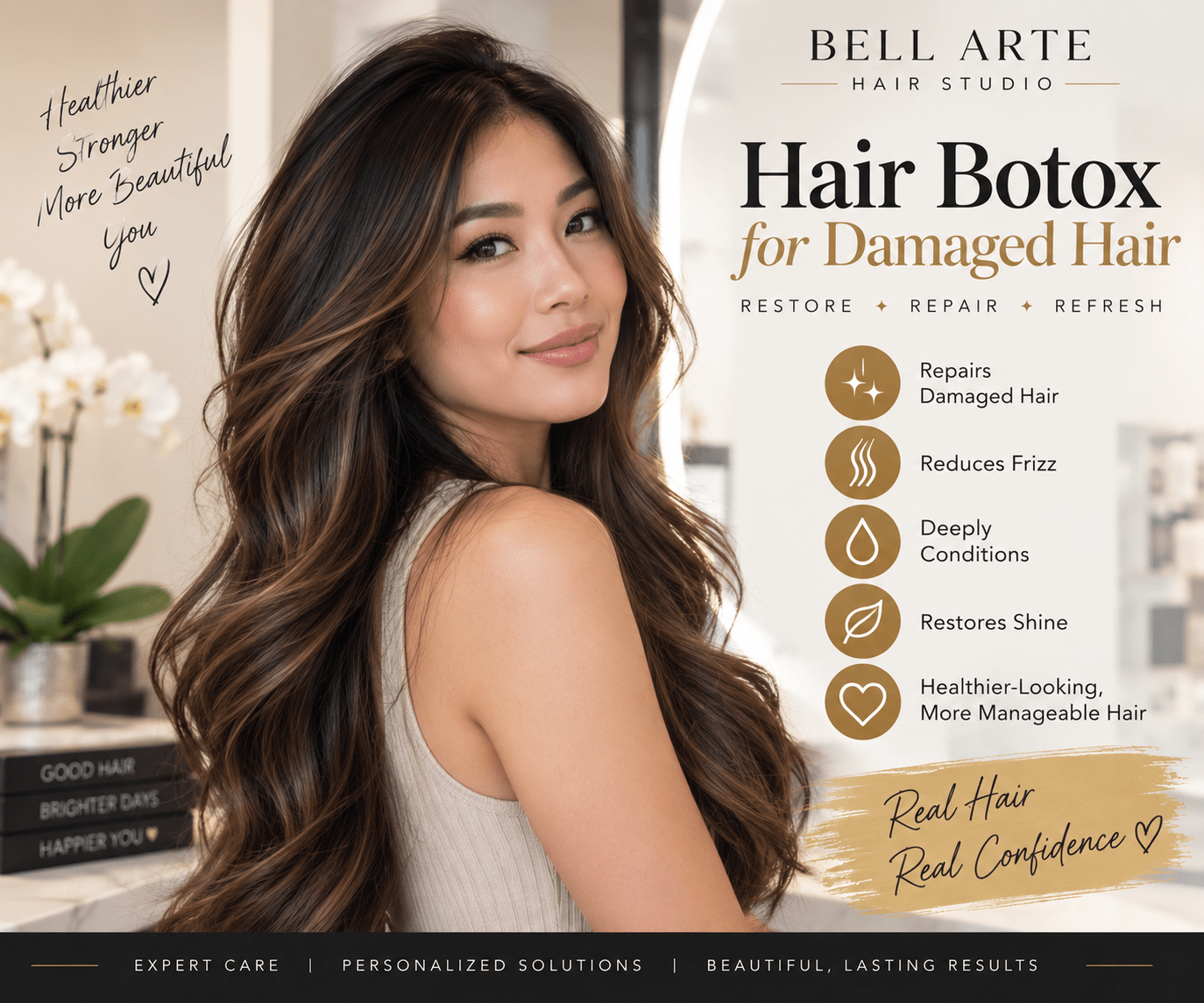
Hair Botox for Damaged Hair: Benefits, Results & Aftercare
Hair Botox for damaged hair is a deep-conditioning salon treatment designed to improve the appearance of dry, frizzy, porous, or chemically stressed hair. Instead of injections or botulinum toxin, professional Hair Botox formulas use conditioning ingredients that help smooth and nourish the hair. Proper Hair Botox aftercare can also play an important role in maintaining softness, shine, frizz control, and manageability after your salon treatment.
Heat styling, hair coloring, bleaching, environmental exposure, and everyday wear can leave hair looking dull, rough, and difficult to manage. A professional Hair Botox service offers a conditioning-focused approach for people who want healthier-looking hair without assuming that every smoothing treatment works the same way.
This guide explains how the treatment works, why people choose Hair Botox for damaged hair, how it compares with keratin treatments, what results you may notice, possible considerations, and the Hair Botox aftercare steps that can help maintain your results.
What Is Hair Botox for Damaged Hair?
Hair Botox is an intensive conditioning and smoothing service. Despite the name, the treatment does not involve Botox injections or botulinum toxin. The beauty industry uses the term because the treatment aims to give dry or stressed hair a smoother, fuller, more polished appearance.
Professional formulas vary by manufacturer. Many contain combinations of proteins, amino acids, conditioning agents, oils, vitamins, collagen-related ingredients, and moisturizing components. Together, these ingredients condition and coat the hair shaft, helping rough or porous areas look and feel smoother.
At Bell Arte Hair Studio, Hair Botox is available as part of our professional hair treatments in Tampa. A professional consultation can help determine whether Hair Botox or another conditioning treatment better matches your hair type, condition, and goals.
How Does Hair Botox Work on Damaged Hair?
Bleaching, coloring, frequent heat styling, UV exposure, friction, and other environmental factors can affect the outer cuticle of the hair. As the surface becomes rougher or more porous, strands may lose shine, tangle more easily, feel coarse, and become increasingly difficult to manage.
Hair Botox for damaged hair focuses on conditioning these stressed areas. Its formula coats and conditions the hair fibers, helping create a smoother surface and improve the hair’s cosmetic appearance.
Do not confuse this conditioning process with permanently regenerating damaged hair. The visible portion of each strand consists primarily of nonliving keratinized fibers. Professional conditioning can improve appearance, softness, smoothness, and manageability, but it cannot biologically regenerate the existing hair fiber.
What Are the Benefits of Hair Botox for Damaged Hair?
Results vary according to your starting hair condition, the formula your stylist uses, the application technique, and your home-care routine. However, people often choose Hair Botox for damaged hair for several cosmetic benefits.
- Smoother texture: Conditioning ingredients can help create a smoother, more polished hair surface.
- Reduced frizz: Improved conditioning may make frizzy or porous hair easier to manage.
- Increased shine: A smoother surface can reflect light more evenly and create a glossier appearance.
- Improved softness: Deep conditioning can help dry or rough strands feel softer.
- Better manageability: Conditioned hair may become easier to brush, blow-dry, and style.
- Healthier-looking ends: Conditioning can improve the appearance of dry or stressed lengths and ends.
- Fuller appearance: Smoother, conditioned strands may give some hair a healthier and more substantial appearance.
How Is a Hair Botox Treatment Applied?
The exact application process depends on the professional formula. Your stylist should follow the manufacturer’s directions for the specific product used during your appointment.
Step 1: Cleansing
Most services begin with a thorough shampoo to remove oils, styling products, and buildup. Some professional systems call for a clarifying shampoo during preparation.
Step 2: Sectioning and Application
After preparing the hair, your stylist divides it into sections and carefully distributes the Hair Botox formula throughout the appropriate lengths. Careful sectioning helps create even coverage.
Step 3: Processing
Next, the formula remains on the hair for the amount of time recommended by the manufacturer. Processing times can vary among products.
Step 4: Finishing
Depending on the system, your stylist may rinse the hair completely or leave a specified amount of product before finishing. Many professional systems then use blow-drying and controlled heat to create a smooth, polished result.
Hair Botox for Damaged Hair vs. Keratin Treatments
Hair Botox and keratin treatments can both create smoother, more manageable hair, but they are not necessarily the same type of service.
Hair Botox generally emphasizes intensive conditioning, hydration, smoothing, and improving the cosmetic appearance of dry or damaged hair.
Keratin treatments, on the other hand, use protein-based smoothing systems and may produce different levels of frizz reduction or straightening depending on the particular product and technique.
If you are deciding between the two, you can also learn about Bell Arte’s professional keratin treatments. Your stylist can evaluate your hair and help determine which service better matches your desired result.
Ingredients also vary among smoothing products. The U.S. Food and Drug Administration explains that some hair smoothing products contain or release formaldehyde when heated, while formulations differ among manufacturers. Consumers should review ingredients and ask their salon professional about the product being used. Read the FDA information about hair smoothing products and formaldehyde for additional guidance.
Does Hair Botox Straighten Damaged Hair?
Rather than permanently straightening the hair, Hair Botox primarily focuses on conditioning and smoothing.
Some people notice a straighter appearance after treatment because reducing frizz and smoothing the surface can create a sleeker finish. In general, though, the service aims to improve condition and manageability rather than permanently change your natural curl or wave pattern.
Is Hair Botox Good for Dry and Frizzy Hair?
Dry and frizzy hair represents one of the main reasons people consider Hair Botox for damaged hair.
Porous strands can react strongly to humidity and environmental moisture. When the outer surface becomes rough, the hair may appear frizzy, dull, or uneven.
Deep conditioning can help smooth that surface, potentially reducing the appearance of frizz and making styling easier. Results vary according to texture, porosity, condition, formula, and environmental conditions.
Can You Use Hair Botox on Colored or Bleached Hair?
People with colored, highlighted, or bleached hair often seek additional conditioning because chemical processing can leave their strands feeling dry or porous.
Whether a particular Hair Botox product suits color-treated hair depends on the formula, current condition, previous chemical services, and timing between treatments.
Before receiving the service, tell your stylist about recent coloring, bleaching, relaxing, smoothing, or other chemical treatments. This information helps the stylist evaluate your hair and select an appropriate approach.
Can Hair Botox Help Fine or Thin-Looking Hair?
Hair Botox does not create new hair follicles or treat medical hair loss. However, improving the condition and appearance of individual strands can sometimes make the overall hairstyle look smoother, healthier, and fuller.
Fine hair requires special consideration because an overly heavy conditioning formula could weigh down delicate strands. A stylist can evaluate your density, texture, and condition before recommending a product.
How Long Do Hair Botox Results Last?
The treatment produces temporary cosmetic results. How long those results remain noticeable varies according to the formula, hair type, washing frequency, styling habits, swimming, environmental exposure, and Hair Botox aftercare.
Some professional treatments remain noticeable for several weeks or longer. Because formulas differ, follow your stylist’s recommendations for the particular product used during your service instead of relying on one universal timeline.
Frequent washing, harsh cleansers, excessive heat, and poor maintenance may cause the smoothing and conditioning effects to fade more quickly.
Hair Botox Aftercare: How to Maintain Your Results
Proper Hair Botox aftercare begins with following the instructions for the specific professional product your stylist used. Different formulas may have different recommendations regarding washing, styling, heat, and maintenance.
Your daily routine can also influence how long the smooth, conditioned appearance lasts.
- Follow your stylist’s washing instructions: Ask when you should shampoo your hair after treatment.
- Use gentle haircare products: Choose shampoo and conditioner appropriate for professionally treated hair.
- Maintain moisture: Regular conditioning can help dry lengths and ends remain soft and manageable.
- Use heat protection: Apply a thermal protectant before blow-drying, curling, or flat-ironing your hair.
- Limit excessive heat: Frequent exposure to very high temperatures can contribute to additional dryness and damage.
- Protect your hair while swimming: Chlorinated pool water and salt water can affect professionally treated and color-processed hair.
- Reduce friction: Handle wet hair gently and consider smooth pillowcase fabrics to minimize nighttime friction.
Hair Botox Aftercare: When Can You Wash Your Hair?
One of the most common Hair Botox aftercare questions involves when to shampoo after the appointment.
No single waiting period applies to every Hair Botox product. Certain systems may allow washing sooner than others. For the best guidance, follow the instructions from your stylist and the manufacturer of the exact formula used on your hair.
A product-specific approach provides more reliable guidance than assuming that every Hair Botox treatment requires the same waiting period.
What Shampoo Should You Use After Hair Botox?
Your stylist may recommend gentle products that complement professionally treated hair. The ideal shampoo depends on the specific Hair Botox formula, your natural hair type, color services, scalp condition, and styling routine.
Instead of automatically choosing a product simply because its label says it works with Hair Botox, ask which shampoo and conditioner pair well with the professional formula used during your service.
Can Heat Styling Affect Hair Botox Results?
Heat styling can affect dry, color-treated, and professionally conditioned hair. You do not necessarily need to eliminate blow-drying, curling, or flat-ironing, but reasonable temperatures and a suitable thermal protectant can help reduce unnecessary stress.
Good Hair Botox aftercare focuses on protecting the strands from excessive stress that could contribute to dryness and make the cosmetic benefits fade more quickly.
Is Hair Botox Formaldehyde-Free?
The term “Hair Botox” alone does not tell you exactly which ingredients a product contains. Manufacturers use different formulas, so consumers should review the specific product rather than assuming that every Hair Botox treatment contains identical ingredients.
If avoiding formaldehyde or formaldehyde-releasing ingredients matters to you, ask your stylist which product the salon uses and review the manufacturer’s ingredient and safety information.
The FDA recommends checking certain hair smoothing products for ingredients such as formaldehyde, formalin, and methylene glycol. You can read the agency’s consumer information about formaldehyde in hair smoothing products for more information.
Possible Hair Botox Risks and Considerations
Formulas vary, and any cosmetic hair product can potentially cause sensitivity or irritation in some people.
Before treatment, tell your stylist about known allergies, scalp sensitivity, recent chemical services, previous reactions to hair products, or significant scalp irritation.
Also, do not assume that every product marketed as “natural,” “gentle,” or “Hair Botox” contains identical ingredients. Professional evaluation and ingredient transparency remain important.
If you experience significant burning, irritation, breathing problems, or another unexpected reaction during any salon treatment, tell your stylist immediately.
Professional Hair Botox vs. At-Home Treatments
Consumers can purchase products marketed as Hair Botox for home use, but professional salon services offer several advantages.
A trained stylist can evaluate your hair before treatment, choose an appropriate professional formula, distribute the product evenly, control processing and heat, and adjust the service according to your hair’s texture, density, condition, and chemical history.
This professional evaluation becomes particularly important when considering Hair Botox for damaged hair that has undergone extensive bleaching, coloring, or previous chemical services.
Frequently Asked Questions About Hair Botox for Damaged Hair
Is Hair Botox good for damaged hair?
Yes, this professional conditioning service can improve the cosmetic appearance and manageability of dry, frizzy, porous, or stressed hair. Hair Botox for damaged hair focuses on intensive conditioning and smoothing, although it does not permanently regenerate damaged hair fibers.
Does Hair Botox repair split ends?
Dry or split ends may look smoother after treatment because conditioning improves their appearance. However, the treatment cannot permanently reconnect a physically split hair fiber. Trimming remains the most effective way to remove split ends.
Does Hair Botox contain actual Botox?
No. The treatment does not involve botulinum toxin injections. The beauty industry uses the term “Hair Botox” to describe the smoother, conditioned, and rejuvenated appearance the service aims to create.
Does Hair Botox permanently straighten hair?
No. This service primarily conditions and smooths the strands. Reduced frizz may make the hair appear straighter, but the treatment generally does not permanently alter your natural curl or wave pattern.
Can Hair Botox help frizzy hair?
Yes. Deep conditioning and smoothing can reduce the appearance of frizz and make hair easier to manage. Results vary according to hair type, condition, humidity, product formula, and aftercare.
Can I get Hair Botox after coloring my hair?
Possibly, but timing and product compatibility matter. Tell your stylist about recent coloring, bleaching, highlighting, or other chemical services so they can evaluate your hair before treatment.
How can I make Hair Botox last longer?
Good Hair Botox aftercare can help maintain your results. Follow your stylist’s washing recommendations, use gentle haircare products, condition regularly, protect your hair from excessive heat, and minimize unnecessary environmental stress.
Is Hair Botox for Damaged Hair Worth It?
Hair Botox for damaged hair may be worth considering when your goals include smoother texture, improved softness, increased shine, easier styling, and better control of dry or frizzy hair.
For the best results, select the treatment according to your individual hair rather than simply following a trend. Texture, porosity, density, chemical history, current condition, and desired result all influence which salon treatment makes the most sense.
Final Thoughts on Hair Botox for Damaged Hair and Hair Botox Aftercare
For people dealing with dry, frizzy, porous, or chemically stressed strands, Hair Botox for damaged hair offers a conditioning-focused option. The treatment can help create softer, smoother, shinier, and more manageable hair, although individual results vary according to the starting condition and product.
Just as importantly, good Hair Botox aftercare can help preserve those cosmetic benefits. Gentle cleansing, conditioning, heat protection, careful styling, and following your stylist’s product-specific recommendations can help maintain your results.
Before choosing Hair Botox, consider scheduling a professional consultation to determine whether the service fits your hair’s condition and goals. An experienced stylist can evaluate your hair, explain the specific formula, discuss expected results, and recommend an appropriate aftercare routine.