
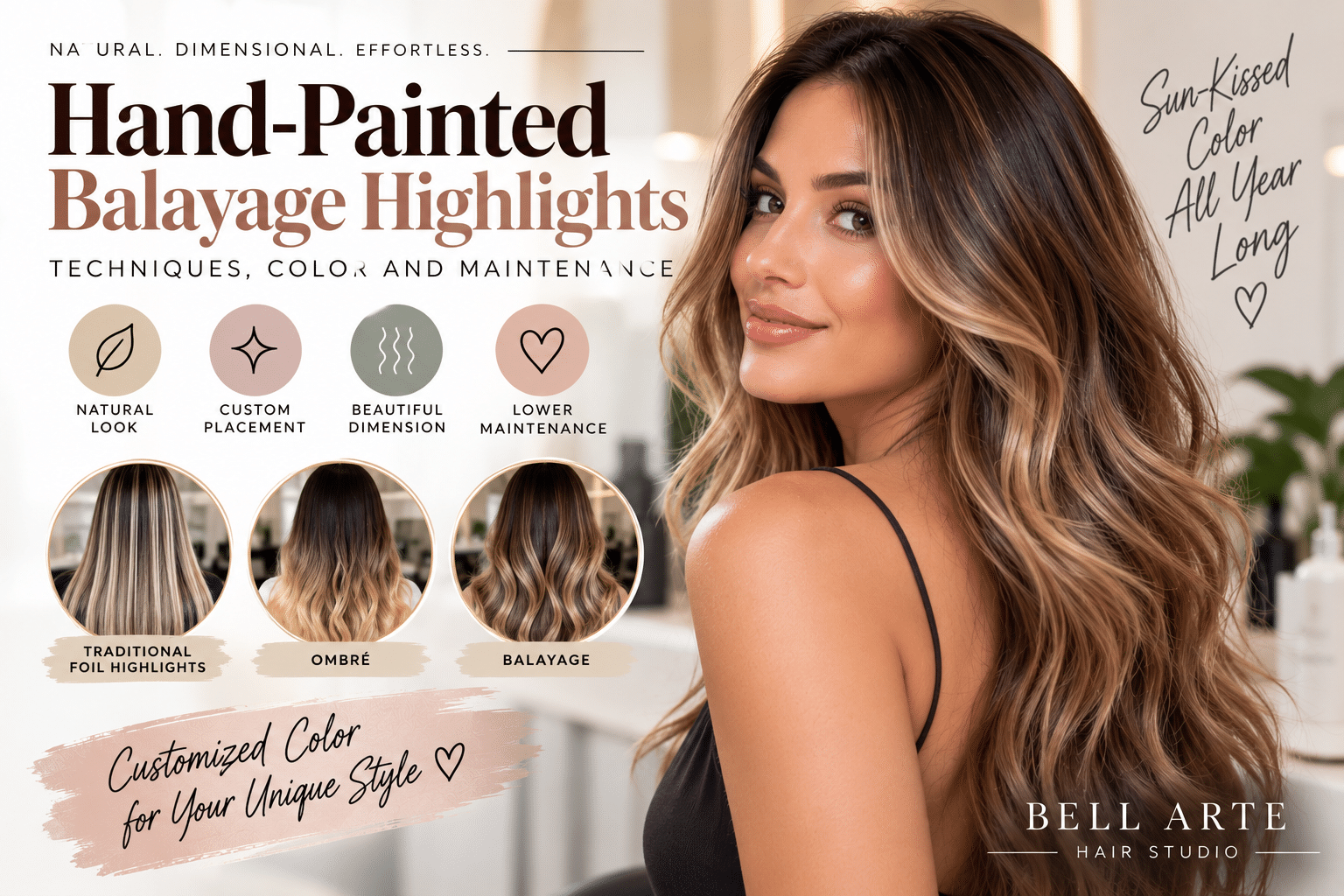
Hand-Painted Balayage Highlights: Techniques, Color and Maintenance
Hand painted balayage highlights create soft, dimensional color by placing lightener strategically throughout the hair instead of following a rigid highlighting pattern. A skilled colorist can customize the placement, brightness, tone, and blend according to your natural color, haircut, skin tone, and desired result.
The technique works especially well for clients who want natural-looking dimension without an obvious line of regrowth. Depending on your starting color and goals, balayage can create anything from subtle caramel ribbons to brighter blonde pieces and dramatic face-framing color.
This guide explains how professional balayage works, how it compares with foils and ombré, what happens during an appointment, and how to maintain balayage hair between salon visits.
If you are considering this service in Tampa, learn more about professional balayage hair coloring at Bell Arte Hair Studio.
How Do Hand-Painted Balayage Highlights Work?
The word “balayage” comes from the French verb associated with sweeping. Instead of following a uniform foil pattern, a colorist uses freehand placement to paint selected areas of the hair.
The stylist controls where each lighter section begins, how much product goes onto the strand, and where the brightest areas appear. This flexibility makes balayage highly customizable.
For example, a stylist may create greater brightness around the face while keeping more depth near the roots and underneath the hair. Another client may prefer subtle ribbons of caramel or honey throughout a brunette base.
L’Oréal Professionnel also describes balayage as a freehand painting or sweeping technique that creates a natural-looking result. You can read its professional explanation of balayage and color maintenance.
Why Does Balayage Look So Natural?
Traditional highlights often follow more structured placement patterns. Balayage gives the colorist greater freedom to decide exactly where light and dimension should appear.
Strategic placement can preserve depth near the root while gradually increasing brightness through the mid-lengths and ends. This variation creates contrast without requiring every section to begin at exactly the same point.
The final result can mimic the multidimensional effect that natural hair develops after repeated sun exposure, but the stylist has much greater control over tone and placement.
Balayage, Foils and Ombré: What’s the Difference?
These terms often appear together, but they do not describe the same thing. Understanding the differences can help you communicate the look you want during your salon consultation.
Traditional Foil Highlights
Foils allow a stylist to isolate sections of hair and control the lightening process. They can create brightness close to the scalp and work especially well when a client wants more uniform highlights or significant lift.
A traditional full highlight may also create a more consistent pattern from the roots through the ends.
Hand-Painted Balayage Highlights
With hand painted balayage highlights, the stylist places lightener according to the desired visual effect rather than following one uniform pattern throughout the entire head.
This approach can create softer transitions, preserve natural depth, and produce a more customized finish. The colorist can also concentrate brightness in areas where it will create the most noticeable dimension.
Ombré Color
Ombré describes a gradient color effect rather than one specific application method. Hair generally transitions from darker color near the roots to significantly lighter color toward the ends.
Balayage can help create an ombré effect, but the two terms are not interchangeable. A stylist can also use balayage to produce subtle highlights that do not resemble a dramatic ombré at all.
Why Custom Balayage Placement Matters
No two clients have exactly the same natural color, haircut, density, texture, face shape, or color history. For that reason, professional balayage should not follow a one-size-fits-all pattern.
Your stylist can decide where brighter pieces will create the most flattering dimension and where preserving depth will improve contrast.
Hair length also influences placement. Long layers provide plenty of space for gradual color transitions, while shorter styles may require more precise positioning to create visible dimension without overwhelming the haircut.
This customization is one of the main advantages of hand painted balayage highlights. Rather than creating the same highlighting pattern for every client, the stylist can adapt the placement to your individual hair and desired result.
Can Brunettes Get Natural-Looking Balayage?
Absolutely. Brunette balayage does not require turning dark hair dramatically blonde.
A colorist can introduce caramel, mocha, honey, beige, or other complementary tones while preserving the richness of the natural base. The amount of contrast depends on your desired result and how much lift your hair can safely achieve.
Subtle placement can add movement and dimension to brunette hair without creating an overly highlighted appearance.
What Are Face-Framing Balayage Highlights?
Face-framing highlights place brighter pieces around the front hairline to draw attention toward the face and add brightness where people notice it most.
Some clients prefer a subtle face frame that blends gently into the rest of their color. Others choose a brighter “money piece” for stronger contrast.
Your stylist can adjust the thickness, brightness, tone, and placement according to your haircut and desired style.
What Happens Before Your Appointment?
A good balayage service starts with a consultation rather than the lightener.
Your stylist should evaluate your current color, previous chemical services, hair condition, texture, porosity, and desired result. Color history becomes particularly important if you previously used permanent color, bleach, box dye, or other chemical services.
Bring inspiration photos when possible, but remember that the same shade can look different on different starting colors. Your stylist can explain what your hair can realistically achieve while protecting its condition.
What to Expect During Your Salon Visit
Balayage appointments vary according to hair length, density, starting color, previous color history, and desired brightness.
A typical appointment may include:
- Consultation: Your stylist reviews your color history and discusses your desired result.
- Color planning: Together, you determine the placement, brightness, tone, and amount of dimension.
- Application: Your stylist paints or places lightener strategically throughout selected sections.
- Processing: The hair lightens while your stylist monitors its progress and condition.
- Rinsing: Once the hair reaches the appropriate level, your stylist removes the lightener.
- Toning: A toner or gloss can refine warmth and create the desired final shade.
- Finishing: Finally, your stylist dries and styles the hair so you can see the complete dimensional result.
The entire appointment may take several hours for more involved transformations. A subtle refresh can require less time than a major color change.
How Do Root Smudges Create a Softer Blend?
A root smudge uses color near the root area to soften the transition between the natural base and lighter pieces.
This technique can reduce visible lines between darker roots and highlights while creating a more lived-in appearance.
Not every balayage service requires a root smudge. Your stylist may recommend one when it improves the overall blend or helps achieve your desired look.
What Is Color Melting?
Color melting blends multiple complementary tones so the transition between shades appears smooth and gradual.
A stylist may use different formulas near the roots, mid-lengths, and ends to create a seamless progression of color.
Combined with strategic lightening, this technique can add depth and produce a highly customized finish.
How to Maintain Balayage Hair at Home
Learning how to maintain balayage hair can help preserve tone, shine, softness, and overall hair condition between salon appointments.
Although balayage often grows out more softly than traditional root-to-end color, the lightened portions still require appropriate care.
Choose Products for Color-Treated Hair
Use shampoo and conditioner designed for color-treated hair. Gentle cleansing and regular conditioning can help maintain softness while protecting your color.
L’Oréal Professionnel notes that color-treated hair behaves differently from untreated hair and requires appropriate maintenance. Its guide to caring for color-treated hair provides additional professional guidance.
Control Unwanted Warmth
Lightened hair can gradually develop unwanted yellow or orange tones because of washing, heat, mineral exposure, environmental factors, and normal toner fading.
Your stylist may recommend a purple, blue, or other toning product depending on your hair color. Avoid assuming that every balayage client needs purple shampoo because the appropriate pigment depends on the unwanted tone.
Protect Hair From Excessive Heat
Apply a thermal protectant before using hot styling tools and avoid temperatures higher than your hair requires.
Repeated excessive heat can contribute to dryness, breakage, and color fading. Keeping styling temperatures reasonable becomes especially important after lightening.
Maintain Moisture and Shine
Lightened hair may require additional conditioning. A moisturizing mask or treatment can help keep the mid-lengths and ends feeling softer and more manageable.
Your stylist can recommend products based on your hair’s texture, porosity, and level of lightening.
Why Does Balayage Sometimes Turn Brassy?
Lightening exposes underlying warm pigments in the hair. Toners help refine those pigments into the desired blonde, beige, caramel, or other shade, but toner does not last forever.
Hard water, mineral buildup, ultraviolet exposure, frequent washing, heat styling, and normal fading can gradually reveal more warmth.
Brassiness does not necessarily mean you need another complete lightening service. Sometimes a professional gloss or toner refresh can restore the desired shade without adding more bleach.
How Often Should You Refresh Your Balayage?
The right schedule depends on your desired brightness, contrast, hair growth, and how softly your original color blends into the highlights.
Some clients return periodically for a toner, gloss, or face-framing refresh while waiting much longer between full lightening appointments.
Clients who prefer a very bright blonde appearance may visit more frequently than those who intentionally choose a subtle, lived-in result.
Instead of following one universal schedule, ask your stylist to create a maintenance plan based on your particular color.
Can Balayage Work on Short Hair?
Yes. Balayage can add dimension and movement to bobs, lobs, and other shorter hairstyles.
Short hair gives the colorist less distance for gradual transitions, so precise placement becomes especially important. Carefully positioned lighter pieces can emphasize texture, layers, and movement without making the style look overly highlighted.
Are Hand-Painted Balayage Highlights Low Maintenance?
Hand painted balayage highlights can offer lower-maintenance regrowth than color that begins directly at the scalp because the stylist can preserve natural depth near the root.
However, low maintenance does not mean no maintenance. Toners fade, lightened hair still needs conditioning, and some clients prefer periodic glosses or face-framing refreshes.
The amount of upkeep ultimately depends on the contrast between your natural color and highlights, the shade you choose, and how polished you want the color to look between major appointments.
Frequently Asked Questions
Does balayage use foils?
Traditional balayage relies on freehand placement, but modern colorists may combine painting with foils, films, or other techniques when they need additional lift or control. Your stylist can select the method that best matches your desired result.
Is balayage the same as highlights?
Balayage creates highlighted pieces, but the application differs from traditional structured foil highlighting. With hand painted balayage highlights, the stylist uses strategic placement to create a softer, more customized effect.
Is balayage the same as ombré?
No. Balayage describes a coloring technique, while ombré describes a gradient color effect that transitions from darker to lighter.
Can brunettes get balayage?
Yes. Brunettes can use balayage to introduce caramel, honey, mocha, beige, blonde, or other complementary tones while maintaining depth in the natural base.
Can you get balayage on short hair?
Yes. Strategic placement can create dimension and movement in shorter cuts such as bobs and lobs.
How long does a balayage appointment take?
Appointment length varies according to your hair length, density, starting color, previous color history, and desired result. More significant transformations generally require more time than subtle refreshes.
How often does balayage need to be touched up?
There is no single schedule for everyone. Some clients maintain their color with occasional toner or gloss appointments and wait considerably longer between full lightening services.
How do you maintain balayage hair and prevent brassiness?
Use color-appropriate hair care, limit excessive heat, manage mineral buildup, and follow your stylist’s toning recommendations. A professional toner or gloss can also refresh unwanted warmth between major color appointments.
Professional Balayage and Dimensional Hair Color in Tampa
Beautiful balayage depends on more than simply painting bleach onto the hair. Placement, saturation, starting color, underlying pigment, toner selection, hair condition, and your desired level of contrast all influence the final result.
Bell Arte Hair Studio provides customized professional hair color services for clients throughout Tampa. We tailor color placement to your natural hair, features, style, and desired level of maintenance.
Whether you want subtle dimension, brighter face-framing pieces, or a more noticeable transformation, professional hand painted balayage highlights can create a customized result that complements your hair and personal style.
Explore our professional hair color and highlight services or schedule a consultation to discuss the balayage look you want to achieve.