
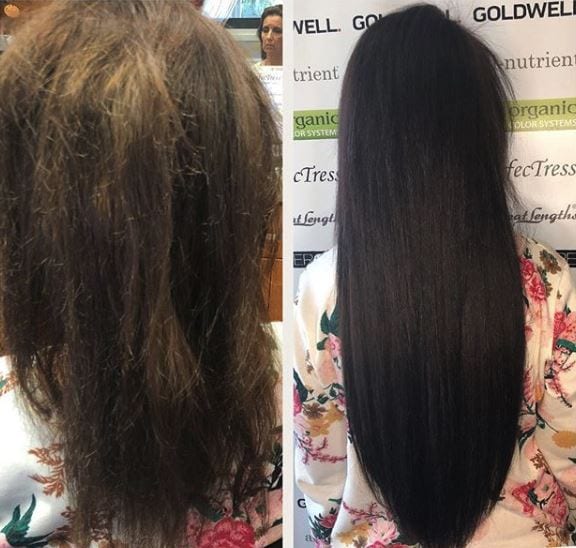
Human Hair Extensions: Common Questions Answered
Considering human hair extensions but still have questions? Professional extensions can add length, volume, density and styling versatility, but the right method depends on your natural hair, lifestyle, desired result and maintenance preferences.
This human hair extensions FAQ answers common questions about extension hair, installation methods, natural-looking results, styling, maintenance, potential damage and professional removal.
What Are Human Hair Extensions?
Human hair extensions are made from real human hair and are added to natural hair to create additional length, volume, density or a combination of these effects.
Professional extensions are available in several attachment methods. Depending on the system, extensions may be installed using keratin bonds, adhesive tabs, beads or other professional attachment techniques.
The extension method is only one part of creating a successful result. Hair quality, color matching, texture matching, placement, weight distribution, blending and maintenance also matter.
What Is the Difference Between Human Hair and Synthetic Hair Extensions?
The primary difference is the fiber.
Human hair extensions are made from real hair, while synthetic extensions are manufactured from artificial fibers.
Quality human hair generally offers greater styling versatility because it behaves more like natural hair. Depending on the hair and manufacturer’s instructions, it can typically be washed, curled, blow-dried and straightened.
Synthetic hair behaves differently. Heat resistance and styling options vary considerably between synthetic products, so the manufacturer’s instructions should always be followed.
Why Choose Human Hair Extensions?
One of the primary advantages of quality human hair is its ability to blend naturally with a client’s own hair when the color, texture, density and placement are properly matched.
Human hair extensions can be used to:
- Add length
- Create additional volume
- Improve the appearance of density
- Enhance certain hairstyles
- Create fuller-looking ends
- Add dimensional color without coloring every strand of natural hair
The desired result should determine how much extension hair is used rather than automatically installing the maximum possible amount.
What Types of Human Hair Extensions Are Available?
Professional human hair extensions are available in several attachment systems.
Common methods include:
- K-Tip or keratin bond extensions
- Tape-In extensions
- I-Tip extensions
- Micro Link extensions
- Weft extensions
- Clip-In extensions
No single method is automatically best for everyone. Natural hair density, strength, texture, lifestyle, styling habits and maintenance preferences should all be considered before choosing an attachment method.
Which Hair Extension Methods Does Bell Arte Offer?
Bell Arte Hair Studio offers several professional human hair extension methods, including:
- K-Tip hair extensions
- Keratin bond extensions
- Tape-In hair extensions
- I-Tip hair extensions
- Micro Link hair extensions
Having multiple methods available allows the extension plan to be customized rather than attempting to use the same attachment system for every client.
Which Human Hair Extensions Are Best?
There isn’t one extension method that is best for every client.
The appropriate method depends on factors such as:
- Natural hair density
- Hair strength and condition
- Natural texture
- Desired length
- Desired volume
- Preferred hairstyles
- Lifestyle
- Maintenance expectations
A professional consultation allows the stylist to evaluate these factors before recommending a method.
What Are K-Tip Hair Extensions?
K-Tip extensions, also known as keratin bond extensions, use individual extension strands attached to small sections of natural hair with keratin-based bonds.
Because the extensions are installed individually, placement can be customized throughout the hair. Individual strands can also provide natural movement and styling flexibility.
What Are Tape-In Hair Extensions?
Tape-In extensions use thin sections of extension hair with adhesive attachment areas. The extensions are positioned around sections of natural hair to add length and volume.
The wider, flatter attachment differs considerably from individual-strand methods such as K-Tips and I-Tips.
Correct placement, weight and concealment are especially important when working with fine or lower-density hair.
What Are I-Tip Hair Extensions?
I-Tip extensions use individual extension strands that are generally secured to sections of natural hair with small beads rather than keratin adhesive.
The strand-by-strand placement allows the stylist to customize where additional hair is positioned.
What Are Micro Link Hair Extensions?
Micro Link extensions use small beads or rings to attach extension hair to natural hair.
I-Tips are one common type of Micro Link installation. However, terminology varies between extension systems, so ask your stylist exactly which technique is being recommended.
Are Human Hair Extensions Made From Real Hair?
Yes. Genuine human hair extensions are made from real human hair.
However, quality varies significantly. The fact that an extension is labeled “human hair” doesn’t automatically mean that all extension hair will have the same longevity, cuticle condition, processing history, texture or performance.
What Is Remy Human Hair?
Remy generally refers to human hair collected and processed in a way intended to keep the cuticles aligned in the same direction.
Maintaining cuticle alignment can help reduce unnecessary friction and tangling compared with poorly processed hair.
However, “Remy” alone shouldn’t be the only factor used to judge extension quality. Processing, sourcing, manufacturing and subsequent care can also affect how the hair performs.
How Are Human Hair Extensions Color Matched?
Natural-looking extensions require more than finding one shade that appears close to your hair.
Many people have multiple tones throughout their natural hair. Therefore, a stylist may blend more than one extension shade to reproduce that dimension.
Color matching should consider:
- Root color
- Mid-length color
- End color
- Highlights
- Lowlights
- Warm or cool undertones
- Overall dimension
Proper matching becomes especially important when the extensions are significantly longer than the client’s natural hair.
What Makes Hair Extensions Look Natural?
Natural-looking results depend on several factors working together.
These include:
- Appropriate extension method
- Correct amount of extension hair
- Strategic placement
- Color matching
- Texture matching
- Proper weight distribution
- Professional blending and cutting
- Correct home care
The attachment points should also be positioned so they can be concealed within the client’s natural hair whenever possible.
Can Hair Extensions Be Used Just for Volume?
Yes. Extensions don’t have to create dramatically longer hair.
They can be installed primarily to increase the appearance of density and fullness, particularly through the sides and ends.
For some clients, additional volume is the main objective while the finished length remains close to their natural hair.
Can Hair Extensions Add Length?
Yes. Adding length is one of the most common reasons people choose extensions.
However, the amount of additional length should make sense for the client’s natural hair, density and desired result.
A significant length transformation generally requires enough extension hair to blend the natural hair into the longer lengths convincingly.
Can You Get Extensions With Short Hair?
Potentially. Whether extensions will blend successfully depends on the haircut, natural length, density and desired finished length.
Very short or heavily layered hair can be more challenging because there must be enough natural hair to conceal attachment points and blend into the extension hair.
A consultation is the best way to determine whether your current haircut can support the transformation you want.
Can You Get Hair Extensions With Thin or Fine Hair?
Some clients with thin or fine hair can wear extensions successfully, but the method, extension weight and placement need careful consideration.
Fine hair may have less natural density available to support and conceal attachments. Therefore, installing too much weight or choosing inappropriate placement can create unnecessary stress or visible attachment points.
Bell Arte evaluates natural density, strand strength, texture and overall hair condition before recommending extensions for fine hair.
Can Someone Have Hair That Is Too Thin for Extensions?
Yes. Not everyone is automatically an appropriate candidate for semi-permanent extensions.
If natural hair is extremely sparse, fragile, actively breaking or unable to adequately support the attachment weight, a stylist may recommend avoiding certain methods or extensions altogether.
The goal should be to work within the limits of the natural hair rather than forcing an installation.
Do Hair Extensions Damage Natural Hair?
Hair extensions can place mechanical stress on natural hair because additional weight is being attached to it.
Problems are more likely when extensions are too heavy, installed with excessive tension, poorly maintained, left in beyond the appropriate maintenance period or removed incorrectly.
Proper method selection, professional installation, appropriate weight distribution, home care and professional maintenance can help reduce unnecessary stress.
Can Hair Extensions Cause Traction Alopecia?
Hairstyles or extensions that repeatedly pull on natural hair can contribute to traction alopecia.
Persistent tightness, pain or excessive pulling should not simply be considered a normal part of wearing extensions.
The American Academy of Dermatology explains how repeated tension from hairstyles and extensions can contribute to hair loss and why reducing prolonged pulling is important.
Should Hair Extensions Hurt?
An extension installation should not create persistent pain.
Some clients may initially notice the attachment points because they are unfamiliar, but significant pain, excessive tightness, persistent headaches or obvious pulling should be discussed with your stylist.
Don’t assume that severe discomfort is simply something you need to tolerate.
How Long Do Human Hair Extensions Last?
There isn’t one lifespan that applies to every human hair extension system.
How long extensions remain installed and how long the extension hair itself can be used are also two different questions.
Longevity depends on:
- Extension method
- Quality of the extension hair
- Natural hair growth
- Home care
- Heat styling
- Product use
- Maintenance schedule
- Whether the method allows the hair to be reused
Your stylist should explain the expected wear and maintenance requirements for the particular system you choose.
Are Human Hair Extensions Reusable?
Some extension methods allow extension hair to be reused or reinstalled, while others are typically replaced after their intended wear period.
Reusability also depends on the condition of the extension hair.
For example, some Tape-In and I-Tip systems may allow quality hair to be reused when it remains in suitable condition. Keratin bond installations are handled differently.
Ask about reuse before choosing a method if this is important to your budget or maintenance plan.
How Often Do Hair Extensions Need Maintenance?
Maintenance varies by extension method, natural hair growth and individual installation.
There is no universal schedule that should be applied to every client.
Your stylist should explain the expected maintenance before installation so you understand the ongoing time and financial commitment.
Can Human Hair Extensions Be Washed?
Yes. Professionally installed human hair extensions can be washed, but the technique and products may differ depending on the attachment method.
Follow the instructions provided by your extension stylist.
In general, avoid aggressive rubbing, tangling or pulling around attachment areas.
How Should You Brush Hair Extensions?
Brush gently and support the hair to avoid unnecessary pulling on the attachment areas.
Start by detangling the ends and gradually work upward rather than forcing a brush through tangles from the root.
Your stylist can recommend an extension-appropriate brush based on your installation method.
Can You Curl Human Hair Extensions?
Quality human hair extensions can generally be curled, although you should follow the manufacturer’s and stylist’s recommendations.
Avoid unnecessary excessive heat, and be particularly careful around attachment points that should not be directly exposed to high temperatures.
Can You Straighten Human Hair Extensions?
Human hair extensions can generally be straightened when appropriate heat protection and temperature are used.
However, repeated excessive heat can contribute to dryness and shorten the usable life of extension hair.
The American Academy of Dermatology recommends limiting excessive heat when styling hair, which is also a useful principle when caring for human hair extensions.
Can You Blow-Dry Hair Extensions?
Yes, but follow the care instructions for your particular extension system.
Avoid aggressively pulling on the hair while drying, and pay attention to attachment areas. Some methods require special consideration regarding direct heat.
Can You Put Hair Extensions in a Ponytail?
Many professionally installed extensions can be worn in ponytails and other hairstyles when placement has been planned appropriately.
However, styling flexibility varies according to the attachment method and installation pattern.
If high ponytails, buns or other specific hairstyles are important to you, mention them during your consultation so placement can be planned accordingly.
Can You Swim With Hair Extensions?
Swimming requires additional care because chlorine, salt water, tangling and prolonged wetness can affect both natural hair and extension hair.
Ask your stylist for instructions based on your particular extension method before swimming regularly.
After swimming, follow the recommended cleansing, detangling and drying routine rather than leaving extensions tangled or wet for extended periods.
Can You Exercise With Hair Extensions?
Yes. Many clients maintain active lifestyles while wearing extensions.
However, sweat, frequent washing, ponytails and other exercise-related habits may influence your maintenance routine.
If you exercise frequently, discuss that during your consultation because lifestyle can help determine which method is most practical.
Can You Sleep With Hair Extensions?
Semi-permanent extensions remain installed while sleeping.
Your stylist may recommend securing the hair gently before bed to reduce unnecessary tangling and friction.
Avoid going to sleep with heavily tangled or soaking-wet extension hair.
What Products Should You Use on Human Hair Extensions?
Product recommendations depend on the extension hair and attachment system.
Avoid assuming that every extension method requires exactly the same shampoo, conditioner or styling products.
Some oils, conditioners and styling products may also need to be kept away from attachment areas depending on the system.
Follow the home-care recommendations provided for your particular installation.
Do Hair Extensions Require Sulfate-Free Shampoo?
Not every human hair extension system universally requires sulfate-free shampoo.
The appropriate cleanser depends on the extension hair, attachment method, scalp needs and manufacturer’s recommendations.
Rather than choosing products based solely on a marketing label, ask your extension stylist which shampoo is appropriate for your installation.
Can Human Hair Extensions Be Colored?
Human hair can potentially be colored, but extension hair has often already undergone processing before you receive it.
Therefore, it may respond differently from your natural hair.
Significant color changes, particularly lightening, can affect the quality and condition of extension hair. Professional color matching before installation is usually preferable to relying on major corrective coloring afterward.
Can Extensions Be Used to Add Color Without Coloring Natural Hair?
Yes. Extensions can introduce lighter, darker or dimensional pieces without applying color to every strand of natural hair.
This can be useful for clients who want additional dimension while minimizing chemical processing on selected areas of their natural hair.
Can Hair Extensions Be Cut?
Yes. Professional blending and cutting are often essential to creating a natural-looking result.
Simply installing longer hair without shaping it into the client’s natural haircut can leave an obvious separation between the natural hair and extensions.
The stylist may customize the extensions after installation so the overall shape appears cohesive.
What Happens During a Hair Extension Consultation?
A professional consultation should evaluate more than the length you want.
Your stylist should consider:
- Natural hair density
- Hair strength and condition
- Texture
- Current haircut
- Color
- Desired length
- Desired volume
- Styling habits
- Lifestyle
- Extension history
- Maintenance expectations
Bell Arte provides personalized hair extension consultations so the natural hair can be evaluated before selecting an installation method.
Why Is Professional Hair Extension Removal Important?
Each attachment method has a specific removal process.
Trying to pull, cut, dissolve or otherwise remove semi-permanent extensions without understanding the attachment can unnecessarily damage natural hair.
Professional removal allows the stylist to work systematically through the attachment points while minimizing unnecessary pulling and breakage.
Can Extensions Installed Somewhere Else Be Corrected?
Sometimes. An extension specialist can evaluate the existing installation, natural hair and attachment condition to determine whether maintenance, correction, removal or replacement is appropriate.
Not every installation can simply be repositioned or repaired, so an in-person assessment is important.
How Much Do Human Hair Extensions Cost?
There isn’t one meaningful universal price because extension services vary considerably.
Cost can depend on:
- Extension method
- Quality of hair
- Length
- Amount of hair required
- Installation time
- Color matching
- Customization
- Maintenance requirements
A consultation provides a more accurate estimate because the stylist can determine how much hair and which method are needed to create your desired result.
How Do I Know If Human Hair Extensions Are Right for Me?
The best way to determine candidacy is through a professional evaluation of your natural hair.
Extensions may be appropriate if you want additional length, volume or density and your natural hair can adequately support the recommended method.
However, clients experiencing significant breakage, unexplained hair loss, scalp problems or extremely fragile hair may need to address those concerns before considering semi-permanent extensions.
Why Choose a Hair Extension Specialist?
Hair extension installation requires skills beyond simply attaching additional hair.
An experienced extension specialist should understand method selection, weight distribution, placement, concealment, color matching, blending, maintenance and professional removal.
The stylist should also be willing to tell you when a particular method isn’t appropriate for your natural hair.
Human Hair Extensions at Bell Arte Hair Studio
Bell Arte Hair Studio specializes in professional human hair extensions in Tampa in a private salon setting.
Barbara brings more than 20 years of professional hairstyling experience and works with multiple extension methods, allowing each installation to be customized according to the client’s natural hair, desired length, volume and lifestyle.
Services include K-Tip and keratin bond extensions, Tape-In extensions, I-Tip extensions, Micro Link extensions, professional maintenance, removal and extension correction.
Human Hair Extensions FAQ: The Bottom Line
Human hair extensions can create dramatic length, subtle volume or anything in between, but successful results depend on much more than choosing extension hair.
The attachment method needs to suit your natural hair. The extension hair should be properly matched and blended. Weight and placement should be appropriate, and clients need to understand maintenance before committing to an installation.
If you’re considering extensions, start with a professional consultation rather than selecting a method solely because it is popular online.
Bell Arte Hair Studio
15241 N. Dale Mabry Hwy, Studio #6
Tampa, FL 33618
Phone: (754) 343-0214
Email: bellartesalon@gmail.com