
“`html
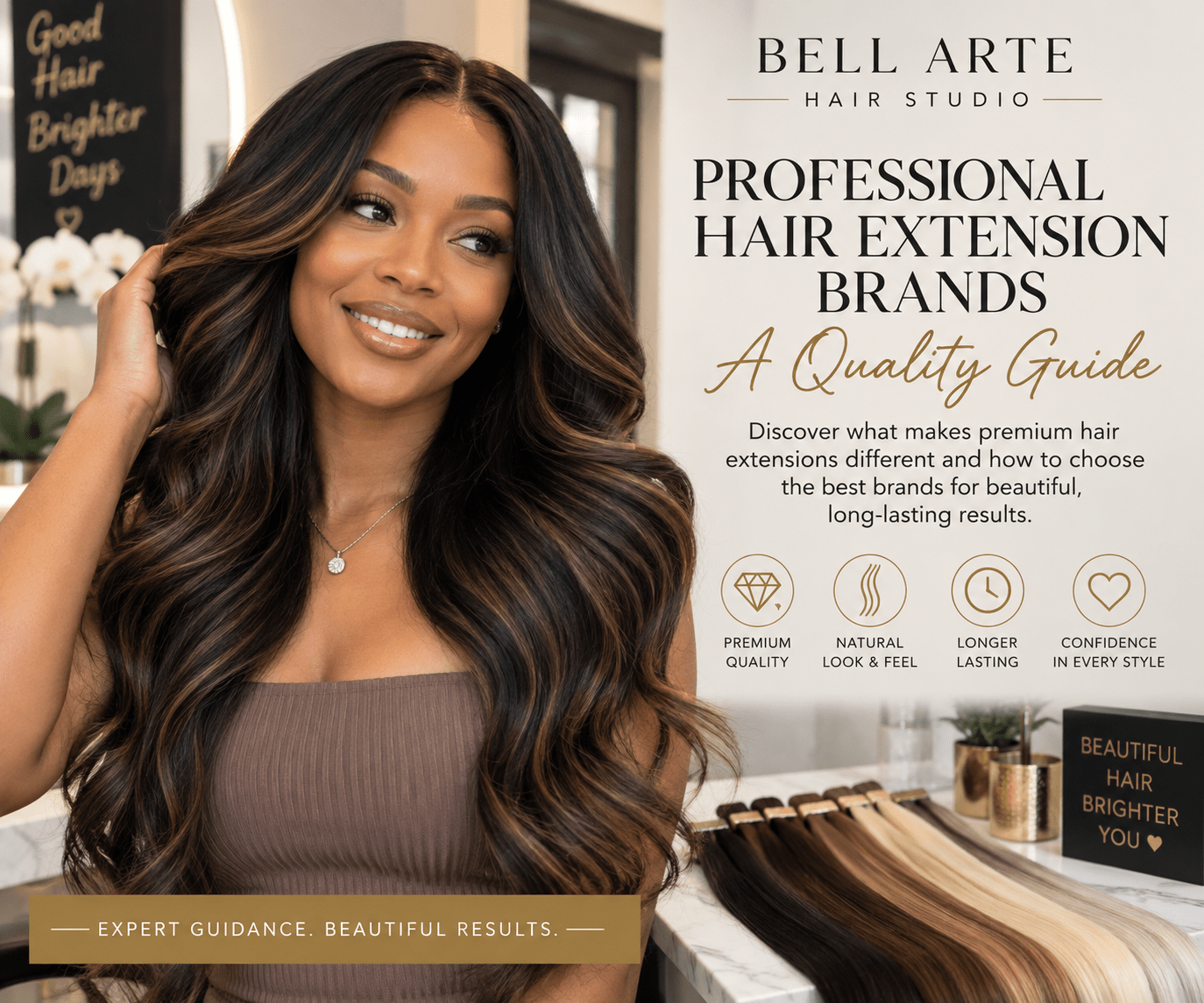
Professional Hair Extension Brands: A Hair Extension Quality Guide
Choosing the right professional hair extension brands can make an enormous difference in how extensions look, feel, blend, and perform over time. Whether you want additional length, fuller volume, or a complete transformation, prioritize quality over price alone. This hair extension quality guide explains what separates premium extension hair from lower-quality alternatives and what to consider when comparing brands that professional stylists use.
The enormous number of extension products available can make choosing the right hair confusing. Hair may look beautiful in a package yet perform very differently after several washes. Hair source, cuticle alignment, processing, density, construction, color treatment, and professional application can all influence the finished result.
At Bell Arte Hair Studio, we specialize in professional hair extensions in Tampa, including premium human hair extensions, tape-ins, keratin bonds, I-tips, micro links, maintenance, removal, and correction. Our approach considers both the quality of the hair and the application method to create a natural-looking result.
What Separates Professional Hair Extension Brands?
The best professional hair extension brands distinguish themselves through raw hair quality, processing methods, construction, consistency, sourcing, and professional support. Premium extension hair should feel attractive because of its natural quality rather than heavy coatings that temporarily create softness.
One of the most important terms to understand is Remy hair. With genuine Remy hair, manufacturers keep the cuticles aligned in the same direction from root to tip. Proper alignment helps reduce friction that can contribute to tangling and matting.
Bell Arte provides additional information about this important distinction in our guide to professional Remy hair extensions.
Great Lengths, for example, states that it uses Remy, double-drawn extension hair and sources its hair in India through a traceable, ethical, and responsible process. You can learn more through the Great Lengths professional hair extensions information.
Hair Extension Quality Guide: What Should You Look For?
A useful hair extension quality guide should go beyond brand names. Even when comparing well-known products, understanding the characteristics of high-quality extension hair helps you ask better questions during your consultation.
Several factors can help distinguish premium extension hair:
- Human hair quality: Look for high-quality human hair that works well with professional styling.
- Cuticle alignment: Properly aligned cuticles help the strands move naturally together and can reduce tangling.
- Hair density: Look for extension hair that maintains attractive density from the upper portion of the strand toward the ends.
- Processing: Excessive chemical processing can affect the appearance, texture, and longevity of extension hair.
- Construction: Quality manufacturers construct bonds, tapes, wefts, and individual strands consistently for their intended application methods.
- Color consistency: Professional products generally provide dependable color options that help experienced stylists create a natural blend.
- Traceability: Transparent sourcing and manufacturing practices can help you understand how a company obtains and processes its hair.
Why Cuticle Alignment Matters in Professional Hair Extensions
Cuticle alignment is one of the most important concepts when evaluating professional hair extension brands. Human hair has an outer cuticle layer composed of overlapping scales. When manufacturers collect and arrange strands in the same natural direction, the cuticles move together more smoothly.
Some lower-quality manufacturers use aggressive processing to remove or alter the cuticle. Surface coatings can make these products feel extremely soft at first, but that initial softness does not necessarily indicate long-term quality.
For this reason, evaluate extension hair based on more than the way a sample feels. Ask about the type of hair, processing methods, Remy quality, maintenance requirements, and which application method works best for your natural hair.
Professional Hair Extension Brands vs. Retail Extension Hair
One of the most important lessons in any hair extension quality guide involves understanding how professional and mass-market products serve different purposes.
Manufacturers often create retail extensions for accessibility and convenience. Professional manufacturers, by comparison, often develop their products for trained stylists who understand color matching, placement, weight distribution, blending, maintenance, and professional removal.
Price alone does not establish quality. An expensive product does not automatically provide superior hair, just as a less expensive product does not automatically provide poor hair. Instead, evaluate the hair itself, its construction, the manufacturer’s reputation, and whether the product suits your natural hair and desired result.
What Is Double-Drawn Human Hair?
Density from root to tip is another important consideration when comparing professional hair extension brands. To create double-drawn hair, manufacturers remove many of the shorter strands so that more hairs within each bundle have similar lengths. This process can create fuller-looking ends and more consistent density.
Single-drawn hair contains a greater mixture of strand lengths. That does not automatically make it unsuitable, but the ends may appear thinner depending on the product and desired hairstyle.
Great Lengths describes its hair as double drawn and states that this process provides consistent volume and length throughout the extension. Its official website also explains its sourcing, production, Remy hair, and sustainability practices.
Weft Construction and Extension Quality
A complete hair extension quality guide should also consider extension construction. Different installation methods require different types of attachment systems.
Manufacturers create machine wefts by using machinery to secure hair along a track. Machine wefts can provide durability, although their thickness and flexibility may differ from other weft designs.
Manufacturers create hand-tied and other thin-weft systems to provide a flatter attachment. The right choice depends on your natural hair density, scalp, desired volume, lifestyle, maintenance preferences, and your stylist’s professional assessment.
No single extension method works best for every person. Professional customization makes choosing an experienced extension specialist just as important as choosing the extension hair itself.
Which Professional Hair Extension Brands Are Well Known?
Several professional hair extension brands have earned recognition among stylists and consumers. Each company offers different products, application methods, color selections, sourcing practices, and professional systems.
Great Lengths
Great Lengths has operated in the professional extension market for decades and has become particularly well known for Remy hair and keratin-bond extension systems. The company states that it responsibly and traceably sources its hair in India and handcrafts its extensions in Italy.
Hairdreams
Hairdreams offers professional extension systems that include individual strand and tape-style options. Before choosing a system, discuss the specific product, application method, maintenance requirements, and suitability for your natural hair with an experienced stylist.
Covet & Mane
Covet & Mane offers professional extension products that include hand-tied and weft-based systems. Weft construction can play an especially important role when a stylist needs to customize placement and create a discreet blend.
Bellami Professional
Bellami Professional offers several professional extension methods, including I-tips, K-tips, tape-ins, and weft systems. Its range of colors and methods gives stylists multiple options when creating customized installations.
Euro So.Cap
Euro So.Cap also serves the professional extension market with human hair extension products and multiple application options.
We do not list these companies to declare one universal winner. The best extension hair for each client depends on hair texture, density, desired length and volume, budget, maintenance commitment, and installation method.
How Ethical Sourcing Relates to Hair Extension Quality
Modern consumers increasingly want to understand where extension hair comes from. As a result, ethical sourcing and traceability have become important considerations when evaluating professional hair extension brands.
Transparent companies help consumers understand how they obtain their hair, work with donors or suppliers, process their products, and maintain manufacturing standards.
Great Lengths publishes information about its sourcing and sustainability practices, including its B Corp certification and production processes. You can review the company’s hair extension sustainability and sourcing information to see the type of transparency consumers can research when comparing manufacturers.
Choosing Extensions for Fine or Delicate Hair
People with fine or delicate natural hair should pay particular attention to extension weight, attachment size, placement, and maintenance. In this situation, a hair extension quality guide needs to consider more than the quality of the extension hair itself.
You also need an attachment method that suits your natural hair. Tape-ins, small keratin bonds, I-tips, micro links, and other systems each offer different characteristics.
An experienced extension specialist can evaluate your natural hair density, texture, condition, and lifestyle before recommending a method. The stylist’s goal should focus on creating additional length or volume while maintaining an appropriate relationship between your natural hair and the weight of the extensions.
Why Professional Installation Matters
Even excellent extension hair can produce disappointing results when a stylist uses poor application, color matching, placement, blending, or maintenance techniques. This is why comparing professional hair extension brands represents only one part of choosing extensions.
A trained extension specialist considers the best position for each attachment, how much natural hair should support it, how to blend the extensions with the haircut, and how the finished style should move.
Professional maintenance and removal matter just as much. As your natural hair grows, the extensions move farther from the scalp. Following the maintenance schedule that your stylist recommends helps keep the installation manageable and attractive.
Hair Extension Quality Guide for Maintenance
Purchasing premium hair is only the beginning. Proper home care plays a major role in keeping professional extensions attractive and manageable.
- Use appropriate haircare products: Follow the product recommendations from your extension specialist.
- Hydrate the lengths and ends: Give extension hair additional conditioning because it does not receive natural scalp oils in the same way as growing hair.
- Brush carefully: Work gently from the ends upward while supporting the attachment area.
- Dry extensions properly: Follow your stylist’s instructions and avoid routinely sleeping with wet extension hair.
- Use heat protection: Apply an appropriate thermal protectant before using hot styling tools.
- Attend maintenance appointments: Follow the maintenance schedule that your stylist recommends for your installation method.
A consistent care routine can help protect the appearance of both your extension hair and your finished style.
How to Compare Professional Hair Extension Brands
Before choosing between professional hair extension brands, ask questions rather than selecting hair based solely on advertising or price.
Useful questions include:
- Does the product use human hair?
- Does the manufacturer use Remy hair with aligned cuticles?
- How heavily does the manufacturer process the hair?
- Does the company provide information about sourcing?
- Does the manufacturer offer single-drawn or double-drawn hair?
- Which installation methods does the manufacturer offer?
- How should you maintain the hair?
- How frequently should you schedule salon maintenance?
- Does the product suit your natural hair density and texture?
- Does your stylist have experience installing this type of extension?
What Is More Important: Brand or Extension Specialist?
Both matter. Premium hair gives the stylist a better foundation, while professional expertise determines how the stylist selects, color matches, places, blends, maintains, and removes the hair.
A recognized brand cannot compensate for an inappropriate installation. Likewise, even an excellent stylist cannot completely overcome poor-quality extension hair.
You get the best results when you combine high-quality hair, an appropriate attachment method, experienced professional installation, personalized placement, and proper maintenance.
Final Thoughts: Choosing Professional Hair Extension Brands
When comparing the best professional hair extension brands, look beyond name recognition. Evaluate hair quality, cuticle alignment, processing, density, construction, sourcing transparency, available application methods, and the professional support behind each product.
Use this hair extension quality guide as a starting point, but remember that your individual needs should guide your decision. Your natural hair texture, density, condition, desired length, volume, lifestyle, and maintenance preferences all influence which extension method and hair will work best for you.
At Bell Arte Hair Studio, we customize professional extension services for each client instead of taking a one-size-fits-all approach. During a consultation, an experienced extension specialist can evaluate your hair and help determine the hair, method, placement, and maintenance plan that best supports your desired look.
“`