
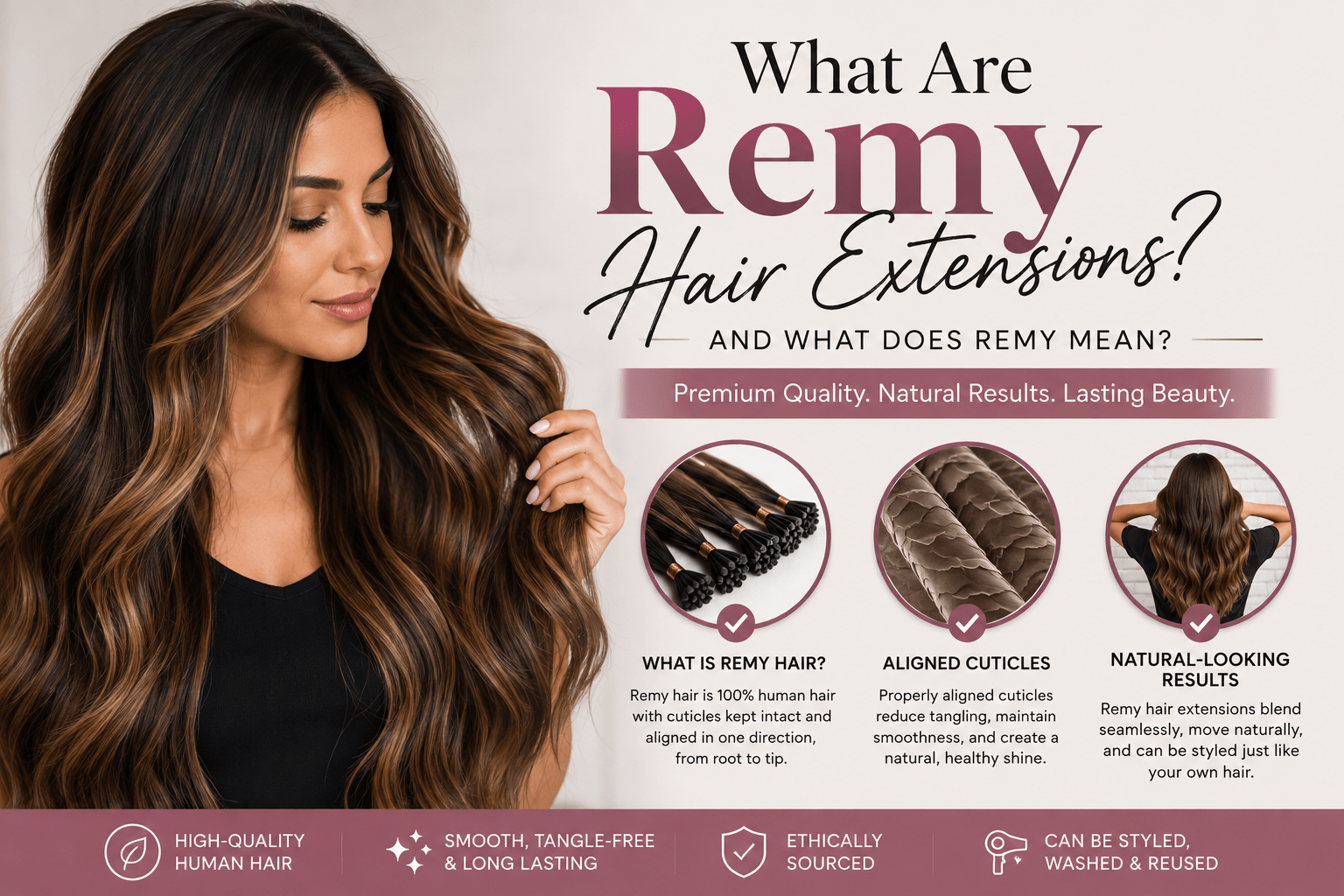
What Are Remy Hair Extensions and What Does Remy Hair Mean?
Remy hair extensions are human hair extensions made with the hair cuticles kept intact and aligned in the same direction, from root to tip. This cuticle alignment is what distinguishes Remy human hair extensions from many lower-quality human hair products.
If you’ve been shopping for hair extensions, you’ve probably seen the terms Remy, Remi, virgin hair, human hair, and non-Remy hair. They can be confusing because they don’t all describe the same thing.
In this guide, we’ll explain what Remy hair extensions are, what the name Remy means, how Remy hair differs from non-Remy and virgin hair, and what to look for when choosing quality human hair extensions.
What Are Remy Hair Extensions?
Remy hair extensions are human hair extensions in which the cuticles are preserved and aligned in the same direction.
Human hair has an outer protective layer called the cuticle. These microscopic overlapping cells form the outer layer of the hair shaft. You can learn more about the anatomy and structure of human hair from the NCBI Bookshelf overview of hair follicle anatomy.
With properly processed Remy hair, the strands are collected and handled in a way that maintains this natural root-to-tip orientation.
This matters because when hair strands are mixed together in opposite directions, their cuticles can rub against one another and contribute to friction, tangling, and matting.
Keeping the cuticles aligned can help Remy extensions maintain a smoother appearance and more natural movement when the hair is properly processed and cared for.
What Does the Name Remy Hair Mean?
In today’s hair extension industry, “Remy” refers primarily to the way human hair is collected and arranged—not a specific brand, extension method, or individual person.
The important characteristic is cuticle alignment. The strands are maintained in the same root-to-tip direction rather than being randomly mixed together during collection and processing.
You may also see the word spelled Remi. Both spellings are used within the hair industry, although “Remy” is especially common when describing premium human hair extensions.
Claims about the precise historical origin or etymology of the industry term vary considerably. For consumers, the more useful question isn’t where the word originated—it’s what a manufacturer or salon means when it labels its extension hair “Remy.”
What Makes Remy Human Hair Extensions Different?
The defining feature of Remy human hair extensions is that the cuticles remain aligned from root to tip.
This can provide several advantages when compared with poorly processed human hair:
- Smoother-feeling extension hair
- Reduced friction between strands
- Less tendency to tangle when properly maintained
- More natural movement
- A more natural-looking finish
- Better manageability
- Greater styling versatility than many synthetic alternatives
However, the word “Remy” alone doesn’t guarantee that every extension product will be the same quality.
Hair quality can also depend on sourcing, processing, coloring, cuticle condition, consistency, manufacturing, storage, and how the extensions are cared for after installation.
When comparing hair quality and installation options, explore our Remy hair extensions in Tampa to learn more about choosing extensions that suit your natural hair and styling goals.
Why Does Cuticle Alignment Matter?
Cuticle alignment matters because hair strands tend to interact more smoothly when their outer cuticle layers are facing the same direction.
Think of the cuticle as overlapping shingles on a roof. On naturally growing hair, those scales point in the same general direction from root to tip.
If human hair is collected without maintaining that orientation, some strands can become reversed. The opposing cuticles may create additional friction as the strands move against each other.
With quality Remy hair extensions, preserving the natural direction of the hair helps maintain smoother movement and manageability.
Remy Hair vs. Non-Remy Hair: What’s the Difference?
The primary difference between Remy and non-Remy human hair is how the hair strands and cuticles are collected, processed, and aligned.
Remy Hair
- Made from human hair
- Cuticles are generally preserved
- Hair is maintained in a consistent root-to-tip direction
- Designed to provide smoother movement and manageability
- May be colored or otherwise processed
Non-Remy Hair
- Can also be made from real human hair
- Strands may be collected without preserving their original direction
- Cuticles may be misaligned
- Hair may undergo additional processing to reduce tangling
- Quality can vary significantly between manufacturers
This is an important distinction because a package labeled “100% human hair” does not automatically mean that the product is Remy hair.
Is Remy Hair the Same as Human Hair?
Remy hair is human hair, but not all human hair extensions are Remy.
“Human hair” tells you what the extension is made from. “Remy” describes how the human hair has been collected and maintained, particularly the alignment of its cuticles.
That’s why two extension products can both be labeled human hair but differ considerably in appearance, texture, manageability, and overall quality.
If you’re considering professional human hair extensions in Tampa, the quality of the extension hair is one of several factors to discuss with your stylist before choosing an installation method.
Is Remy Hair the Same as Virgin Hair?
No. Remy hair and virgin hair describe different characteristics.
Remy refers primarily to the alignment and preservation of the hair’s cuticles.
Virgin hair generally refers to human hair that has not undergone chemical processing such as permanent coloring, bleaching, or chemical texture alteration.
This means hair can potentially be Remy while still having been professionally colored or processed.
When shopping for extensions, don’t assume the terms Remy and virgin are interchangeable.
Can Remy Hair Extensions Be Colored?
Yes, Remy hair extensions may already be professionally colored during manufacturing.
Remy describes cuticle alignment rather than whether the hair has ever been colored.
This allows extension manufacturers to offer Remy hair in a wide variety of shades, including blondes, brunettes, reds, highlights, lowlights, and dimensional colors.
If you’re considering coloring your extensions after purchase, speak with your extension specialist first. Extension hair has already undergone manufacturing and possibly color processing, so additional chemical services should be approached carefully. Research on hair cosmetics and chemical processing is available through this PubMed Central review of hair cosmetics.
Why Are Remy Hair Extensions More Expensive?
Remy hair extensions are often more expensive because maintaining cuticle alignment requires more controlled collection, sorting, processing, and manufacturing.
Quality extension hair also needs to meet expectations for consistency in areas such as:
- Length
- Texture
- Color
- Density
- Cuticle condition
- Processing
- Overall appearance
Higher-quality hair can cost more initially, but price alone doesn’t guarantee quality. The manufacturer, processing methods, extension system, hair length, color, and amount of hair can all affect the final price.
Does Remy Hair Mean Single-Donor Hair?
No. Remy hair does not automatically mean single-donor hair.
This is an important distinction because the terms are sometimes incorrectly used as though they mean the same thing.
Remy refers to maintaining the proper direction and alignment of the hair cuticles.
Single-donor hair means that the hair came from one individual donor. A Remy extension product may contain hair from one donor or multiple donors depending on the manufacturer and product.
If sourcing is important to you, ask the extension company or salon specifically about the origin and processing of the hair they use.
Where Does Remy Hair Come From?
Remy human hair extensions can be sourced from different regions around the world.
You may encounter extension hair marketed using terms such as Indian, European, Russian, Brazilian, Cambodian, or other regional descriptions.
However, geographic labels alone don’t necessarily determine the quality of an extension product.
Collection practices, cuticle alignment, processing, coloring, manufacturing, quality control, and the condition of the finished hair can all be more important than a geographic marketing label.
Is Remy Hair Always High Quality?
No. The Remy label by itself does not guarantee that every hair extension product is premium quality.
Remy describes an important characteristic of human extension hair, but there can still be significant differences between products labeled Remy.
Quality can vary based on:
- How the hair was collected
- How much chemical processing it received
- The condition of the cuticle
- How the hair was colored
- Consistency between strands
- Manufacturing quality
- Hair density from top to bottom
- Quality control
This is why choosing extension hair from a trusted supplier and working with an experienced extension specialist can be just as important as looking for the word “Remy” on the packaging.
How Can You Identify Quality Remy Hair Extensions?
Consumers can’t always determine extension quality simply by looking at the hair, especially when shopping online.
Instead of relying on a single “test,” consider several factors:
Ask About the Hair
Ask your stylist or supplier whether the extensions are human hair, whether the cuticles are intact and aligned, and what processing the hair has undergone.
Look at the Texture and Movement
Quality human hair should generally have natural-looking movement and texture rather than an excessively artificial appearance.
Consider the Ends
Examine whether the extension hair maintains reasonable density through the lengths and ends. Extremely thin or sparse ends may require more extension hair to create a full result.
Ask About Processing
Remy hair can be colored and processed, but excessive processing may affect the condition and longevity of the hair.
Choose a Reputable Hair Extension Specialist
An experienced extension stylist should be able to explain what type of extension hair they use, why they use it, and how clients should care for it.
Are Remy Hair Extensions Good for Thin or Fine Hair?
Remy hair can be used for clients with fine or thin hair, but the quality of the extension hair isn’t the only factor that determines whether extensions are appropriate.
The extension method, attachment size, extension weight, placement, and amount of natural hair available for support are extremely important.
A professional consultation should evaluate:
- Natural hair density
- Individual strand strength
- Existing thinning or breakage
- Hairline density
- Scalp condition
- Desired length and volume
- Extension method
- Amount and weight of extension hair
Fine hair shouldn’t automatically receive the same extension application as thick, dense hair.
What Types of Extensions Can Use Remy Human Hair?
Remy human hair can be used with many professional hair extension methods.
Depending on the manufacturer and extension system, Remy hair may be available as:
- K-tip or keratin bond extensions
- I-tip or microlink extensions
- Tape-in extensions
- Weft extensions
- Clip-in extensions
- Other professional extension systems
If you’re interested in a bead-based method, you can also learn how microlink hair extensions in Tampa use small beads to attach individual extension strands to natural hair.
The term Remy describes the extension hair, not the method used to attach that hair to your natural hair.
How Long Do Remy Hair Extensions Last?
The lifespan of Remy hair extensions varies based on hair quality, extension method, processing, frequency of wear, maintenance, heat styling, products, and home care.
There isn’t one universal lifespan that applies to every Remy extension product.
Some professional extension hair may be reusable depending on the attachment method and the condition of the hair, while other extension systems may be replaced more frequently.
Your stylist should explain the expected lifespan of the specific extension hair being used for your installation.
How Do You Care for Remy Hair Extensions?
Proper care can help maintain the appearance, softness, and manageability of Remy human hair extensions.
Use Extension-Appropriate Hair Products
Use shampoo, conditioner, and styling products recommended for your specific extension hair and installation method.
Keep the Extensions Conditioned
Extension hair doesn’t receive natural scalp oils in the same way your growing hair does. Keeping the lengths and ends appropriately conditioned can help maintain softness and manageability.
Brush Gently
Use the brush and technique recommended by your extension specialist. Begin detangling at the ends and gradually work upward rather than aggressively pulling through tangles.
Be Careful With Heat
Human hair extensions can generally be heat styled, but repeated excessive heat can affect extension hair just as it can affect natural hair.
Follow your stylist’s recommendations regarding temperature and heat-protectant products.
Protect Your Extensions While Sleeping
Avoid going to bed with wet extensions unless your stylist specifically instructs otherwise. Securing long hair appropriately before sleeping can also help reduce unnecessary friction and tangling.
Keep Up With Professional Maintenance
If you’re wearing semi-permanent extensions, follow the maintenance schedule recommended for your particular installation method.
Remy Hair Extensions vs. Synthetic Hair Extensions
Remy hair extensions are made from human hair, while synthetic extensions are manufactured from artificial fibers.
Quality human hair extensions generally provide greater flexibility for styling and can offer movement and texture that closely resemble natural hair.
Synthetic hair can be useful for certain styles and budgets, but heat styling, coloring, washing, and longevity can differ considerably depending on the synthetic fiber.
If natural movement and styling versatility are priorities, professional-quality human hair extensions are often worth discussing during your consultation.
Frequently Asked Questions About Remy Hair Extensions
What are Remy hair extensions?
Remy hair extensions are human hair extensions in which the hair strands are maintained in a consistent root-to-tip direction so the cuticles remain aligned.
What does Remy mean in hair extensions?
In the hair extension industry, Remy generally refers to human hair that has been collected and processed while maintaining the natural alignment of the hair cuticles.
Is Remy hair real human hair?
Yes. Authentic Remy hair is human hair. However, not every human hair extension product qualifies as Remy.
Is Remy hair better than regular human hair?
Cuticle-aligned Remy hair can provide advantages in smoothness, movement, and manageability compared with poorly processed or misaligned human hair. Overall quality still depends on sourcing and manufacturing.
Is Remy hair the same as virgin hair?
No. Remy refers primarily to cuticle alignment, while virgin hair generally refers to human hair that hasn’t undergone chemical coloring or texture processing.
Can Remy hair be colored?
Yes. Remy hair may be professionally colored while still maintaining aligned cuticles. If you want to recolor installed extensions, consult your extension specialist first.
Does Remy mean single-donor hair?
No. Remy and single-donor describe different characteristics. Remy refers to cuticle alignment, while single-donor means the hair originated from one individual.
Why are Remy hair extensions more expensive?
Remy extensions can cost more because preserving cuticle alignment requires controlled collection and processing. Hair quality, length, color, manufacturing, and extension method can also affect price.
How long do Remy hair extensions last?
There is no universal lifespan. Longevity depends on the quality of the hair, extension method, processing, maintenance, styling habits, and home care.
Can you wash and style Remy hair extensions?
Yes. Because Remy extensions are human hair, they can generally be washed and heat styled. Follow the care instructions for your specific extension hair and installation method.
Are Remy Hair Extensions Worth It?
Quality Remy hair extensions can be an excellent choice for clients who want natural-looking human hair with aligned cuticles, smooth movement, and styling versatility.
However, don’t choose extensions based solely on the word “Remy.” The quality of the hair, processing, extension method, professional installation, maintenance, and home care all contribute to the finished result.
The American Academy of Dermatology offers additional guidance on caring for natural hair while wearing extensions, including the importance of avoiding excessive tension and using professional installation.
If you’re comparing extension options, ask your stylist exactly what type of human hair is being used and why it’s appropriate for your natural hair.
For personalized guidance, discover Bell Arte Hair Studio’s professional Remy human hair extension options and discuss which approach best complements your hair.
Looking for Remy Hair Extensions in Tampa?
If you’re considering Remy hair extensions in Tampa, schedule a professional hair extension consultation with Bell Arte Hair Studio in Tampa, Florida.
An experienced extension specialist can evaluate your natural hair, discuss your desired length and volume, explain different extension methods, and help determine which type of Remy human hair extensions may be appropriate for your hair and goals.
Beautiful extensions begin with quality hair, the right extension method, professional installation, and a plan designed around your natural hair.