
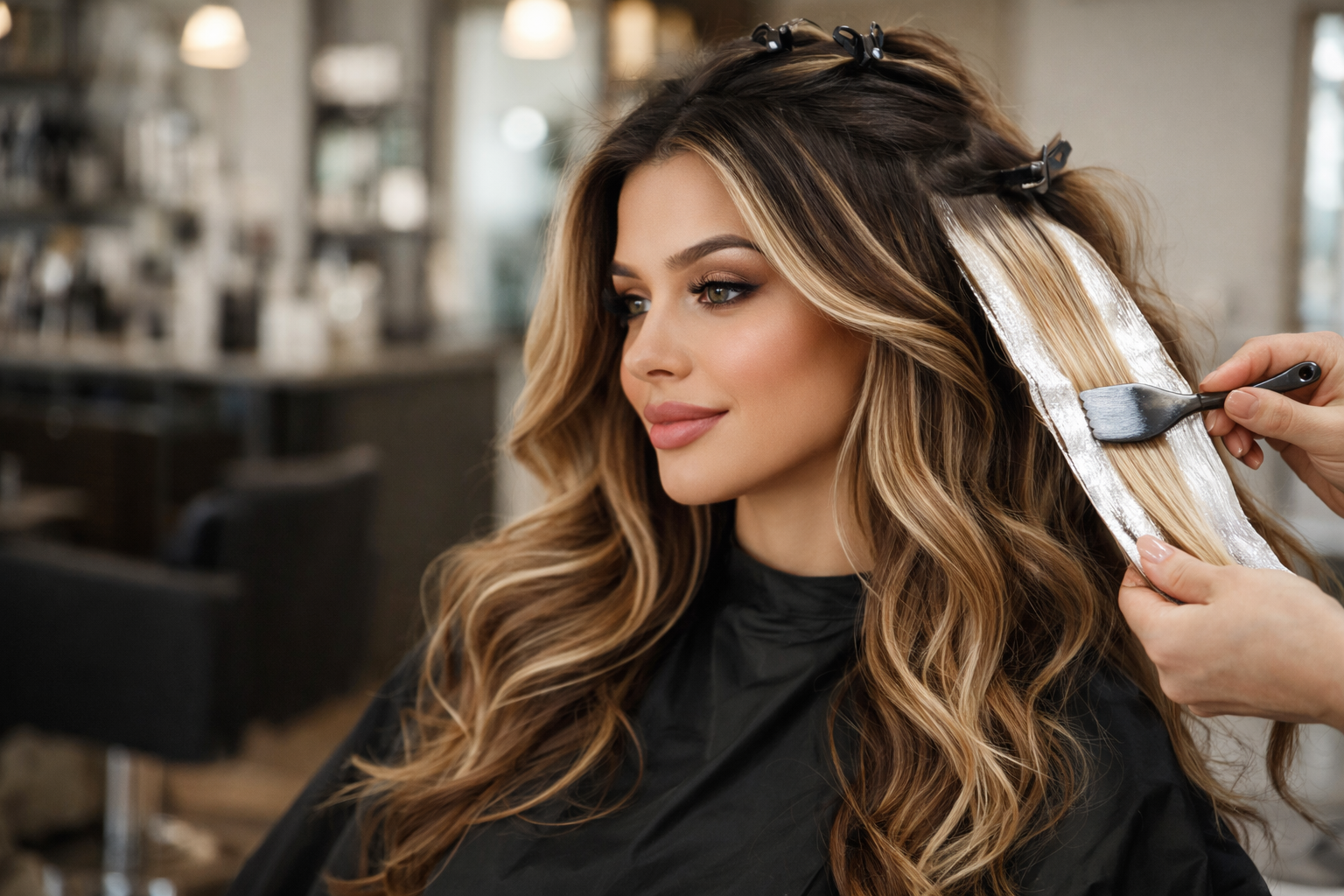
What Is Balayage Hair Coloring? Balayage vs. Highlights
What is balayage hair coloring? Balayage is a customized coloring technique that creates soft, dimensional color by strategically painting lightener or color onto selected sections of hair. Unlike traditional highlighting patterns that often create more uniform brightness, balayage allows a colorist to customize placement around your haircut, natural hair color, texture, and desired result.
The technique can create subtle sun-kissed dimension, brighter face-framing pieces, blonde balayage, brunette balayage, caramel tones, or higher-contrast transformations. Because the placement is customized, two balayage clients can have completely different finished looks.
Balayage also differs from traditional highlights in application, placement, grow-out, and overall appearance. Understanding those differences can help you decide which coloring technique better matches your hair goals.
What Is Balayage Hair Coloring?
Balayage is a professional hair-coloring technique that creates customized dimension and gradual transitions between darker and lighter areas.
The word balayage comes from a French term associated with sweeping, which reflects the hand-painted approach traditionally associated with the technique.
Instead of applying exactly the same highlighting pattern throughout the hair, a colorist can adjust placement according to your natural base, haircut, texture, face-framing goals, and desired brightness.
As a result, balayage can range from extremely subtle and natural-looking to dramatically dimensional.
Balayage vs. Highlights: What’s the Difference?
The biggest difference between balayage vs. highlights involves how the colorist places and distributes the lighter sections.
Traditional highlights commonly use foils to isolate sections of hair. They can create consistent brightness from close to the scalp through the ends. Depending on the desired result, highlights may appear extremely fine and blended or considerably brighter and more defined.
Balayage emphasizes customized placement and softer transitions. A colorist may concentrate brightness around the face, through selected mid-lengths, or toward the ends while preserving more natural depth in other areas.
Neither technique is automatically better. Your starting color, desired brightness, maintenance preferences, and finished look should determine which technique makes more sense.
Does Balayage Always Use Foils?
No. Although people commonly associate balayage with open-air hand painting, professional colorists can use different techniques to achieve the desired lift and finished appearance.
For example, a colorist may isolate certain sections when additional lift or control is necessary. Therefore, seeing foils or another form of separation during your appointment doesn’t automatically mean you aren’t receiving a balayage-inspired result.
The technique should ultimately serve the desired color rather than forcing every client through exactly the same process.
Why Is Balayage So Popular?
Many clients choose balayage because it can create dimension while maintaining natural-looking depth throughout the hair.
Depending on the placement, balayage can provide:
- Soft transitions between darker and lighter hair
- Customized face-framing brightness
- Dimensional hair color
- Softer-looking regrowth with many placements
- Flexible color placement
- Options for blondes, brunettes and redheads
- Customization for different hair lengths and textures
Additionally, balayage doesn’t have to create an extremely blonde result. A colorist can introduce caramel, honey, copper, beige, brunette, or other tones while preserving much of your existing base color.
What Does Balayage Look Like?
There isn’t one universal balayage appearance.
A subtle balayage may add only a small amount of brightness while preserving substantial depth near the roots. Meanwhile, a higher-contrast transformation can incorporate significantly brighter sections around the face, through the mid-lengths, and toward the ends.
Your styling can also change how the dimension appears. Waves and curls often emphasize transitions between different shades, while straight styling can make individual color placement more visible.
For this reason, bring several inspiration photographs to your consultation rather than relying only on the word “balayage.”
Is Balayage Only for Blonde Hair?
No. Balayage describes a coloring technique rather than one specific hair color.
Popular variations include:
- Blonde balayage
- Brunette balayage
- Caramel balayage
- Honey balayage
- Copper balayage
- Red balayage
- Chocolate brunette dimension
- Beige and neutral balayage
- Rose gold or creative-color balayage
Therefore, a professional colorist can adapt the technique to many starting shades and desired results.
Can Brunettes Get Balayage?
Yes. Brunettes can use balayage to add dimension without becoming predominantly blonde.
For example, caramel, honey, chocolate, beige, copper, or lighter brunette sections can create contrast while maintaining an overall brunette appearance.
Alternatively, someone who wants considerably brighter pieces may require additional professional lightening.
Your starting shade, previous color, hair condition, and desired tone will determine how much lightening is appropriate.
Can Blondes Get Balayage?
Yes. Blonde clients can use balayage to create brighter pieces, additional dimension, softer transitions, or strategic brightness around the face.
Blonde balayage doesn’t require making every section lighter. Preserving or introducing appropriate depth can create contrast that makes brighter pieces more noticeable.
Additionally, professional toning can influence whether the finished blonde appears beige, golden, neutral, warmer, or cooler.
Can Red Hair Have Balayage?
Yes. Balayage can add dimension to natural or professionally colored red hair.
Depending on the starting shade, a colorist might incorporate copper, strawberry, golden, or lighter red-inspired sections.
Previously colored red hair may respond differently to lightening than untreated hair. Consequently, giving your stylist an accurate color history becomes particularly important.
Can Balayage Be Customized?
Yes. Customization is one of the primary benefits of balayage.
A professional colorist can adjust:
- Placement
- Brightness
- Contrast
- Face-framing pieces
- Amount of natural color retained
- Warm or cool tones
- Root depth
- Brightness through the ends
For example, one client may want subtle sun-kissed pieces that blend closely with natural brunette hair. Another may prefer significantly brighter blonde sections with dramatic face framing.
Both looks can use balayage techniques even though the finished results appear completely different.
Is Balayage Suitable for Different Hair Types?
Balayage can work with many hair textures, including straight, wavy, and curly hair.
However, an experienced colorist should consider how your hair naturally moves and how you typically style it.
With curly hair, for example, placement can account for where individual curls fall. Straight hair may require particularly careful blending because individual sections can remain more visible without waves or curls to soften the transition.
For the most natural result, the color plan should consider texture as well as your starting color.
Can You Get Balayage on Short Hair?
Yes. Balayage isn’t limited to long hair.
Bobs, lobs, and other shorter hairstyles can incorporate dimensional color through carefully positioned sections.
However, shorter hair provides less distance for gradual color transitions. As a result, strategic placement becomes especially important.
The colorist should consider your haircut and where the lighter sections will fall after styling.
Does Balayage Work on Long Hair?
Yes. Long hair provides plenty of space for creating gradual transitions and dimensional placement.
For example, a colorist can preserve deeper roots, introduce brightness through the mid-lengths, and increase lightness toward selected ends.
Face-framing sections can also receive different placement from the rest of the hair to create additional brightness around the face.
Can Balayage Blend Gray Hair?
Balayage can help blend some gray hair into a dimensional color design, but it isn’t automatically the same as traditional gray coverage.
The appropriate approach depends on the amount and location of gray hair, your natural base, and whether you want complete coverage or softer blending.
In some situations, a colorist may combine several techniques to address gray hair while maintaining dimensional color.
Discuss gray coverage specifically during your consultation so your stylist understands your expectations.
How Long Does Balayage Last?
There isn’t one universal timeline for balayage.
The lightened portions remain changed until they grow out or receive additional color. However, toners, glosses, and the overall appearance of the color can gradually change.
How frequently you need salon maintenance depends on:
- How close the color begins to the scalp
- Contrast between your natural and lightened hair
- Your preferred tone
- How quickly your hair grows
- Whether you need gray coverage
- How bright you prefer your face-framing pieces
- Your home-care routine
Because many balayage designs preserve depth near the root, regrowth can appear softer than highlighting patterns that begin very close to the scalp.
How Often Should Balayage Be Touched Up?
Maintenance varies from one client to another.
Someone with subtle, blended placement may allow the color to grow for a longer period. In contrast, a client with bright face-framing pieces or a specific toner preference may want maintenance sooner.
You also may not need a complete balayage service at every appointment. Depending on your color, your stylist might recommend a toner, gloss, face-frame refresh, partial service, or another maintenance option.
What Is a Balayage Toner?
A professional toner or gloss can refine the finished shade after lightening.
For example, toning can help create beige, golden, neutral, warmer, or cooler results depending on your starting color and desired finish.
Toner doesn’t perform the same job as the initial lightening process. Instead, it refines the tone of hair after lightening.
Because toner can gradually change with washing and environmental exposure, you may need a toner refresh before you need another complete balayage service.
Does Balayage Damage Hair?
Balayage itself describes a coloring technique. However, chemical lightening processes the hair and can affect its condition.
Several factors influence how much stress the hair experiences, including its starting condition, desired level of lift, previous chemical history, processing, and frequency of additional lightening.
An experienced colorist should evaluate your hair before deciding how much lightening it can reasonably handle.
Can Previously Colored Hair Get Balayage?
Possibly. Previous artificial color can significantly affect how your hair responds to a balayage service.
Tell your stylist about previous:
- Permanent color
- Box dye
- Black hair color
- Highlights
- Bleaching
- Fashion colors
- Henna
- Color corrections
- Chemical smoothing services
Artificial pigment may remain inside the hair even when the previous shade appears faded.
Consequently, previously colored hair may lighten differently from untreated hair and require a customized approach.
Can Balayage Correct Old Highlights?
In some situations, dimensional coloring techniques can create a softer appearance around older highlights.
The appropriate correction depends on the existing color and desired result.
Your stylist may need to add depth, lighten selected sections, tone unwanted shades, or combine several techniques.
Bring an accurate color history and allow your stylist to examine your hair before deciding on a corrective process.
How Long Does a Balayage Appointment Take?
Appointment times vary considerably.
A subtle partial balayage on shorter hair may take less time than a major transformation on long, dense, or previously colored hair.
Your appointment can include consultation, sectioning, application, processing, rinsing, toning, conditioning, drying, and styling.
If you need substantial color correction or lightening, achieving your desired result may require additional time or more than one appointment.
What Should You Bring to a Balayage Consultation?
Bring several inspiration photographs showing the type of color you want.
Ideally, choose images that demonstrate:
- Desired brightness
- Root depth
- Face-framing placement
- Overall contrast
- Warm or cool tones
- Desired brightness through the ends
Also tell your stylist about your previous color history and normal styling routine.
Photos help because words such as “natural,” “blonde,” “caramel,” and “bright” can mean very different things to different people.
How Should You Care for Balayage Hair?
Follow the home-care recommendations your stylist provides for your specific hair and professional color service.
General considerations include using products appropriate for color-treated hair, conditioning according to your hair’s needs, limiting unnecessary high-temperature styling, and using heat protection with hot tools.
Swimming and prolonged sun exposure can also affect hair color and condition. Therefore, clients who spend significant time outdoors or in swimming pools may need additional protection and maintenance.
The American Academy of Dermatology provides additional healthy hair-care recommendations involving washing, conditioning, drying, brushing, and heat styling.
What Are the Best Balayage Maintenance Tips?
Good balayage maintenance helps preserve both your hair’s condition and the appearance of your color.
Useful habits include:
- Follow your stylist’s recommended washing routine
- Use products appropriate for color-treated hair
- Condition according to your hair’s needs
- Use heat protection before hot tools
- Limit unnecessary high-temperature styling
- Rinse your hair after swimming
- Consider toner or gloss refreshes when needed
- Schedule trims to maintain healthy-looking ends
Most importantly, maintaining balayage doesn’t always require repeating the entire original service. Your stylist can determine which areas actually need refreshing.
Can You Use Purple Shampoo on Balayage?
It depends on your balayage shade and the tone you want to maintain.
Purple-pigmented products generally help counter unwanted yellow tones in lighter hair. However, they aren’t appropriate for every balayage color.
For example, someone intentionally wearing warm honey or golden balayage may not want to neutralize those tones.
Ask your colorist whether a pigmented shampoo fits your particular color before adding one to your routine.
Balayage vs. Ombre: What’s the Difference?
Balayage describes a coloring technique and placement approach, while ombre generally describes a visual transition from darker hair into progressively lighter or differently colored ends.
The two concepts can overlap.
For example, a colorist can use hand-painted techniques to create an ombre-inspired transition. However, not every balayage is ombre, and not every ombre result requires exactly the same application method.
Balayage vs. Full Highlights: Which Should You Choose?
The right choice depends on your desired result rather than which technique is currently more popular.
Full highlights may suit someone who wants consistent brightness distributed throughout the hair, including closer to the scalp.
Balayage may better suit someone seeking customized dimension, softer transitions, or strategic brightness.
Professional colorists can also combine techniques when a customized result requires more than one approach.
How Do You Choose the Right Balayage Color?
Consider more than a single trending photograph.
Your colorist should evaluate your:
- Natural or current base color
- Previous color history
- Hair condition
- Haircut
- Texture
- Desired contrast
- Maintenance preferences
- Styling habits
Someone who wants minimal visible regrowth, for example, may prefer a different placement from someone seeking maximum brightness around the face.
Why Choose a Professional for Balayage?
Professional balayage requires more than painting lightener onto random sections of hair.
An experienced colorist considers where brightness should begin, how sections should blend, how much depth to preserve, how your hair will respond to lightening, and how the finished color will complement your haircut and texture.
Professional evaluation becomes even more important when your hair contains previous artificial color or has undergone chemical processing.
Frequently Asked Questions About Balayage
Is balayage low maintenance?
It can be. Many balayage designs preserve depth near the roots, which can create softer-looking regrowth than some traditional highlighting patterns. However, maintenance depends on placement, tone, contrast, and your desired appearance.
Does balayage start at the roots?
Not necessarily. Placement can begin at different points depending on your desired result. Some designs preserve considerable natural depth, while others introduce brighter pieces closer to the face or scalp.
Can balayage look natural?
Yes. Subtle placement can create soft dimension similar to naturally lightened hair. Balayage can also produce brighter, higher-contrast results when desired.
Can you get balayage on dark brown hair?
Yes. Dark brown hair can incorporate caramel, honey, beige, lighter brunette, or brighter shades depending on your desired result and how your hair responds to professional lightening.
Can you get balayage without becoming blonde?
Yes. Balayage can add subtle dimension using shades that remain within brunette, copper, red, or other color families.
Does balayage require toner?
A toner or gloss may refine the finished shade after lightening. Whether you need one depends on your starting hair, lightening result, and desired tone.
How often should balayage be refreshed?
There is no universal schedule. Some clients maintain their color with occasional toner, gloss, or face-framing appointments before repeating a larger balayage service.
Can balayage be customized around my haircut?
Yes. Your colorist can plan placement around layers, face framing, length, texture, and how you normally style your hair.
Professional Balayage at Bell Arte Hair Studio
If you’re considering balayage in Tampa, Bell Arte Hair Studio offers customized professional color based on your starting shade, hair condition, previous services, desired brightness, tone, and maintenance preferences.
Barbara has more than 20 years of professional hairstyling experience and can determine the placement and color approach that best complement your hair.
Learn more about Bell Arte’s Balayage Hair Coloring in Tampa service or explore additional Organic Hair Color & Highlights options.
Bell Arte Hair Studio
15241 N. Dale Mabry Hwy, Studio #6
Tampa, FL 33618
Phone: (754) 343-0214
Email: bellartesalon@gmail.com